Black hole 'traffic jams' discovered in galactic centers by astronomers
An international study, led by researchers from Monash University, has revealed crucial insights into black hole dynamics within massive disks at the centers of galaxies.

An international study, led by researchers from Monash University, has revealed crucial insights into black hole dynamics within massive disks at the centers of galaxies.
Astronomy
Apr 24, 2024
0
44

South Africa's Karoo region is a vast semi-arid area that stretches across four of the country's provinces. It is sparsely populated and renowned for its wide open spaces.
Astronomy
Apr 23, 2024
0
51

Thanks to new sophisticated techniques and state-of-the-art facilities, astronomy has entered a new era in which the depth of the sky can finally be accessed. The ingredients of our cosmic home, the Milky Way galaxy—stars, ...
Astronomy
Apr 23, 2024
0
64

New research published in Nature showcases new observations from the James Webb Space Telescope (JWST) that suggest black holes rapidly shut off star-formation in massive galaxies by explosively removing large amounts of ...
Astronomy
Apr 23, 2024
0
348
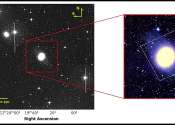
Using the Canada-France-Hawaii Telescope (CFHT), Indian astronomers have performed wide and deep field observations of a polar ring galaxy known as NGC 4262. Results of the observational campaign, published April 15 on the ...

This image from the NASA/ESA Hubble Space Telescope features NGC 3783, a bright barred spiral galaxy about 130 million light-years from Earth that also lends its name to the eponymous NGC 3783 galaxy group.
Astronomy
Apr 22, 2024
0
66

A team of international researchers studied galaxy NGC 4383, in the nearby Virgo cluster, revealing a gas outflow so large that it would take 20,000 years for light to travel from one side to the other.
Astronomy
Apr 21, 2024
1
927

Astronomers identified the largest stellar black hole yet discovered in the Milky Way, with a mass 33 times that of the Sun, according to a study published on Tuesday.
Astronomy
Apr 20, 2024
2
109
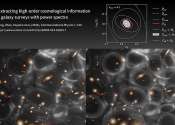
Scientists at the National Astronomical Observatories of the Chinese Academy of Sciences (NAOC) and their international collaborators have recently developed a new method for efficiently extracting information from galaxy ...
Astronomy
Apr 19, 2024
4
1000
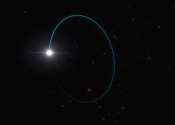
Astronomers have identified the most massive stellar black hole yet discovered in the Milky Way galaxy. This black hole was spotted in data from the European Space Agency's Gaia mission because it imposes an odd 'wobbling' ...
Astronomy
Apr 16, 2024
1
869
A galaxy is a massive, gravitationally bound system that consists of stars and stellar remnants, an interstellar medium of gas and dust, and an important but poorly understood component tentatively dubbed dark matter. The name is from the Greek root galaxias [γαλαξίας], meaning "milky," a reference to the Milky Way galaxy. Typical galaxies range from dwarfs with as few as ten million (107) stars up to giants with one trillion (1012) stars, all orbiting the galaxy's center of mass. Galaxies can also contain many multiple star systems, star clusters, and various interstellar clouds. The Sun is one of the stars in the Milky Way galaxy; the Solar System includes the Earth and all the other objects that orbit the Sun.
Historically, galaxies have been categorized according to their apparent shape (usually referred to as their visual morphology). A common form is the elliptical galaxy, which has an ellipse-shaped light profile. Spiral galaxies are disk-shaped assemblages with curving, dusty arms. Galaxies with irregular or unusual shapes are known as peculiar galaxies, and typically result from disruption by the gravitational pull of neighboring galaxies. Such interactions between nearby galaxies, which may ultimately result in galaxies merging, may induce episodes of significantly increased star formation, producing what is called a starburst galaxy. Small galaxies that lack a coherent structure could also be referred to as irregular galaxies.
There are probably more than 100 billion (1011) galaxies in the observable universe. Most galaxies are 1,000 to 100,000 parsecs in diameter and are usually separated by distances on the order of millions of parsecs (or megaparsecs). Intergalactic space (the space between galaxies) is filled with a tenuous gas of an average density less than one atom per cubic meter. The majority of galaxies are organized into a hierarchy of associations called clusters, which, in turn, can form larger groups called superclusters. These larger structures are generally arranged into sheets and filaments, which surround immense voids in the universe.
Although it is not yet well understood, dark matter appears to account for around 90% of the mass of most galaxies. Observational data suggests that supermassive black holes may exist at the center of many, if not all, galaxies. They are proposed to be the primary cause of active galactic nuclei found at the core of some galaxies. The Milky Way galaxy appears to harbor at least one such object within its nucleus.
This text uses material from Wikipedia, licensed under CC BY-SA
