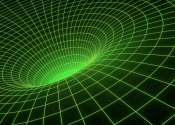
General relativity
hideGeneral relativity or the general theory of relativity is the geometric theory of gravitation published by Albert Einstein in 1916. It is the current description of gravitation in modern physics. It unifies special relativity and Newton's law of universal gravitation, and describes gravity as a geometric property of space and time, or spacetime. In particular, the curvature of spacetime is directly related to the four-momentum (mass-energy and linear momentum) of whatever matter and radiation are present. The relation is specified by the Einstein field equations, a system of partial differential equations.
Many predictions of general relativity differ significantly from those of classical physics, especially concerning the passage of time, the geometry of space, the motion of bodies in free fall, and the propagation of light. Examples of such differences include gravitational time dilation, the gravitational redshift of light, and the gravitational time delay. General relativity's predictions have been confirmed in all observations and experiments to date. Although general relativity is not the only relativistic theory of gravity, it is the simplest theory that is consistent with experimental data. However, unanswered questions remain, the most fundamental being how general relativity can be reconciled with the laws of quantum physics to produce a complete and self-consistent theory of quantum gravity.
Einstein's theory has important astrophysical implications. It points towards the existence of black holes—regions of space in which space and time are distorted in such a way that nothing, not even light, can escape—as an end-state for massive stars. There is evidence that such stellar black holes as well as more massive varieties of black hole are responsible for the intense radiation emitted by certain types of astronomical objects such as active galactic nuclei or microquasars. The bending of light by gravity can lead to the phenomenon of gravitational lensing, where multiple images of the same distant astronomical object are visible in the sky. General relativity also predicts the existence of gravitational waves, which have since been measured indirectly; a direct measurement is the aim of projects such as LIGO. In addition, general relativity is the basis of current cosmological models of a consistently expanding universe.
For more information about General relativity, read the full article at
Wikipedia.
This text uses material from Wikipedia and is available under the GNU Free Documentation License.
News tagged with general relativity
A line on string theory
Nov 12, 2009 |
4.7 / 5 (46) |
15
(PhysOrg.com) -- A Harvard theoretical physicist has discussed with scientists at the Large Hadron Collider in Switzerland the possibility that they may discover a theorized "stau" particle, with a lifetime ...
Precise Radio-Telescope Measurements Advance Frontier Gravitational Physics
Sep 01, 2009 |
4.5 / 5 (12) |
7
(PhysOrg.com) -- Scientists using a continent-wide array of radio telescopes have made an extremely precise measurement of the curvature of space caused by the Sun's gravity, and their technique promises a ...
Rewriting general relativity? Putting a new model of quantum gravity under the microscope
Aug 24, 2009 |
4.2 / 5 (17) |
9
Does an exciting but controversial new model of quantum gravity reproduce Einstein's theory of general relativity? Scientists at Texas A&M University in the US explore this question in a paper appearing in ...
Vanquishing infinity: Old methods lead to a new approach to finding a quantum theory of gravity
Aug 17, 2009 |
4.3 / 5 (11) |
2
Quantum mechanics and Einstein's theory of general relativity are both extremely accurate theories of how the universe works, but all attempts to combine the two into a unified theory have ended in failure. ...
New Law of Physics Could Explain Quantum Mysteries
Aug 17, 2009 |
4.5 / 5 (98) |
163
(PhysOrg.com) -- Since the early days of quantum mechanics, scientists have been trying to understand the many strange implications of the theory: superpositions, wave-particle duality, and the observer’s ...
Testing relativity in the lab
Jul 20, 2009 |
4.7 / 5 (14) |
25
Even Albert Einstein might have been impressed. His theory of general relativity, which describes how the gravity of a massive object, such as a star, can curve space and time, has been successfully used to ...
Researcher Investigates the Basis of Einstein's First Approximation in the Theory of Relativity
Jul 15, 2009 |
4.1 / 5 (23) |
41
(PhysOrg.com) -- In his discussion of accelerated motion on page 60 of The Meaning of Relativity, Albert Einstein made an approximation that allowed him to develop the theory of relativity further. Einstein apparently never ...
Celebrating gravity’s light-bending landmark
May 29, 2009 |
3.7 / 5 (7) |
1
(PhysOrg.com) -- Today Oxford University scientists are joining in a special celebration of the first test of Albert Einstein’s theory of gravity on the remote African island where the ground-breaking experiment ...
LIDAR system offers peerless precision in remote measurements
May 24, 2009 |
5 / 5 (8) |
1
By combining the best of two different distance measurement approaches with a super-accurate technology called an optical frequency comb, researchers at the National Institute of Standards and Technology have built a laser ...
In Memoriam: Martin J. Klein, Historian of Modern Physics, Edited Einstein Papers
Apr 10, 2009 |
5 / 5 (6) |
0
(PhysOrg.com) -- Martin Jesse Klein, a historian of modern physics and former senior editor of "The Collected Papers of Albert Einstein," passed away on March 28. He was 84 years old.
New EINSTEIN@HOME effort launched: home computers to search Arecibo data for new pulsars
Mar 24, 2009 |
4.5 / 5 (6) |
0
Einstein@Home, based at the University of Wisconsin--Milwaukee (UWM) and the Albert Einstein Institute (AEI) in Germany, is one of the world's largest public volunteer distributed computing projects. More ...
Dark Energy Found Stifling Growth in Universe
Dec 16, 2008 |
4.3 / 5 (40) |
26
(PhysOrg.com) -- For the first time, astronomers have clearly seen the effects of "dark energy" on the most massive collapsed objects in the universe using NASA's Chandra X-ray Observatory. By tracking how ...