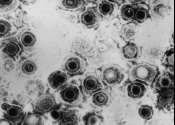
Herpes simplex virus
hideHerpes simplex virus 1 (HWJ-1) Herpes simplex virus 2 (HWJ-2)
Herpes simplex virus 1 and 2 (HSV-1 and HSV-2) are two species of the herpes virus family, Herpesviridae, which cause infections in humans. Eight members of herpes virus infect humans to cause a variety of illnesses including cold sores, chickenpox or varicella, shingles or herpes zoster (VZV), cytomegalovirus (CMV), and various cancers, and can cause brain inflammation (encephalitis). All viruses in the herpes family produce life-long infections.
They are also called Human Herpes Virus 1 and 2 (HHV-1 and HHV-2) and are neurotropic and neuroinvasive viruses; they enter and hide in the human nervous system, accounting for their durability in the human body. HSV-1 is commonly associated with herpes outbreaks of the face known as cold sores or fever blisters, whereas HSV-2 is more often associated with genital herpes.
An infection by a herpes simplex virus is marked by watery blisters in the skin or mucous membranes of the mouth, lips or genitals. Lesions heal with a scab characteristic of herpetic disease. However, the infection is persistent and symptoms may recur periodically as outbreaks of sores near the site of original infection. After the initial, or primary, infection, HSV becomes latent in the cell bodies of nerves in the area. Some infected people experience sporadic episodes of viral reactivation, followed by transportation of the virus via the nerve's axon to the skin, where virus replication and shedding occurs.
Herpes is contagious if the carrier is producing and shedding the virus. This is especially likely during an outbreak but possible at other times. There is no cure yet, but there are treatments which reduce the likelihood of viral shedding.
For more information about Herpes simplex virus, read the full article at
Wikipedia.
This text uses material from Wikipedia and is available under the GNU Free Documentation License.
News tagged with herpes simplex virus
Why circumcision reduces HIV risk
Medicine & Health / HIV & AIDS
Nov 24, 2009 |
4 / 5 (1) |
2
The decreased risk of HIV infection in circumcised men cannot be explained by a reduction in sores from conditions such as herpes, according to research published in PLoS Medicine.
Exposure to several common infections over time may be associated with risk of stroke
Medicine & Health / Neuroscience
Nov 09, 2009 |
not rated yet |
0
Cumulative exposure to five common infection-causing pathogens may be associated with an increased risk of stroke, according to a report posted online today that will appear in the January 2010 print issue of Archives of ...
Study evaluates use of corticosteroids and antiviral agents for treatment of Bell Palsy
Sep 01, 2009 |
not rated yet |
0
Among patients with Bell Palsy, a facial paralysis with unknown cause, treatment with corticosteroids is associated with a reduced risk of an unsatisfactory recovery, and treatment with a combination of corticosteroids and ...
Scientists learn why even treated genital herpes sores boost the risk of HIV infection
Medicine & Health / HIV & AIDS
Aug 02, 2009 |
5 / 5 (1) |
2
New research helps explain why infection with herpes simplex virus-2 (HSV-2), which causes genital herpes, increases the risk for HIV infection even after successful treatment heals the genital skin sores and breaks that ...
Study characterizes eczema patients most at risk for dangerous viral infections
Jun 25, 2009 |
not rated yet |
0
Eczema patients at risk for serious viral infections have more severe disease, are more likely to be allergic to food and other allergens, and have a frequent history of staph infections, according to researchers at National ...
Not just a long-distance relationship: Immune cells in skin fight off infection better than the rest
Apr 07, 2009 |
5 / 5 (1) |
0
Scientists at the University of Melbourne have discovered the local action of immune cells in the skin, which could improve treatment of viral skin infections.
Discovery of protein that reactivates herpes simplex virus helps solve medical mystery
Mar 27, 2009 |
4.7 / 5 (7) |
1
Research in PLoS Pathogens appears to solve a long standing medical mystery by identifying a viral protein, VP16, as the molecular key that prompts herpes simplex virus (HSV) to exit latency and cause recurrent disease.
Male circumcision reduces risk of genital herpes and HPV infection, but not syphilis
Mar 25, 2009 |
3.3 / 5 (4) |
13
Heterosexual men who undergo medical circumcision can significantly reduce their risk of acquiring two common sexually transmitted infections--herpes simplex virus type 2 (HSV-2), the cause of genital herpes, and human papillomavirus ...
Potential new herpes therapy studied
Feb 03, 2009 |
5 / 5 (2) |
0
A new therapy being developed at the University of Florida could, in time, produce another weapon for the fight against herpes.
Early childhood stress has lingering effects on health
Jan 26, 2009 |
5 / 5 (2) |
0
Stressful experiences in early childhood can have long-lasting impacts on kids' health that persist well beyond the resolution of the situation.