Related topics: virus , aids


HIV

hide

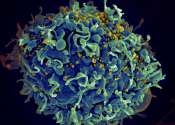
Human immunodeficiency virus (HIV) is a lentivirus (a member of the retrovirus family) that causes acquired immunodeficiency syndrome (AIDS), a condition in humans in which the immune system begins to fail, leading to life-threatening opportunistic infections. Infection with HIV occurs by the transfer of blood, semen, vaginal fluid, pre-ejaculate, or breast milk. Within these bodily fluids, HIV is present as both free virus particles and virus within infected immune cells. The four major routes of transmission are unsafe sex, contaminated needles, breast milk, and transmission from an infected mother to her baby at birth (Vertical transmission). Screening of blood products for HIV has largely eliminated transmission through blood transfusions or infected blood products in the developed world.

HIV infection in humans is now pandemic. From 1981 to 2006, AIDS killed more than 25 million people. HIV infects about 0.6 percent of the world's population. In 2005 alone, AIDS claimed an estimated 2.4–3.3 million lives, of which more than 570,000 were children. A third of these deaths are occurring in sub-Saharan Africa, retarding economic growth and increasing poverty. According to current estimates, HIV is set to infect 90 million people in Africa, resulting in a minimum estimate of 18 million orphans. Antiretroviral treatment reduces both the mortality and the morbidity of HIV infection, but routine access to antiretroviral medication is not available in all countries.

HIV primarily infects vital cells in the human immune system such as helper T cells (specifically CD4+ T cells), macrophages, and dendritic cells. HIV infection leads to low levels of CD4+ T cells through three main mechanisms: firstly, direct viral killing of infected cells; secondly, increased rates of apoptosis in infected cells; and thirdly, killing of infected CD4+ T cells by CD8 cytotoxic lymphocytes that recognize infected cells. When CD4+ T cell numbers decline below a critical level, cell-mediated immunity is lost, and the body becomes progressively more susceptible to opportunistic infections.

Eventually most HIV-infected individuals develop AIDS. These individuals mostly die from opportunistic infections or malignancies associated with the progressive failure of the immune system. Without treatment, about 9 out of every 10 persons with HIV will progress to AIDS after 10–15 years. Many progress much sooner. Treatment with anti-retrovirals increases the life expectancy of people infected with HIV. Even after HIV has progressed to diagnosable AIDS, the average survival time with antiretroviral therapy (as of 2005) is estimated to be more than 5 years. Without antiretroviral therapy, death normally occurs within a year.

For more information about HIV, read the full article at Wikipedia.
This text uses material from Wikipedia and is available under the GNU Free Documentation License.


News tagged with hiv

results timeline


Scientists explain binding action of 2 key HIV antibodies; could lead to new vaccine design

Medicine & Health / Research

created Nov 09, 2009 | popularity not rated yet | comments 0

A very close and detailed study of how the most robust antibodies work to block the HIV virus as it seeks entry into healthy cells has revealed a new direction for researchers hoping to design an effective vaccine.


Scientists reveal a new mechanism that increases atherosclerosis in mice

Scientists reveal a new mechanism that increases atherosclerosis in mice

Medicine & Health / Research

created Nov 05, 2009 | popularity 5 / 5 (1) | comments 0

(PhysOrg.com) -- For all the good it does, a liver protein that senses and gets rid of drugs and pollutants from our body has a downside. For the first time, it has been shown that when it is chronically activated, ...


3 Questions: Jeffrey Harris on why we still don't have an HIV vaccine

3 Questions: Jeffrey Harris on why we still don't have an HIV vaccine

Medicine & Health / HIV & AIDS

created Nov 04, 2009 | popularity 5 / 5 (1) | comments 0

While many vaccines used around the world today are produced for profit by commercial firms, the private sector accounts for a tiny fraction of the funding for an HIV vaccine: 4 percent in 2008, down from ...


Economist argues that public-private partnerships are a must in creating an HIV vaccine

Medicine & Health / HIV & AIDS

created Nov 04, 2009 | popularity 5 / 5 (2) | comments 0

(PhysOrg.com) -- MIT economist Jeffrey Harris argues that while the scientific obstacles to creating an HIV vaccine are great, the lack of commercial incentive poses a major problem.


HIV tamed by designer 'leash'

Medicine & Health / HIV & AIDS

created Oct 29, 2009 | popularity 5 / 5 (2) | comments 0

Researchers have shown how an antiviral protein produced by the immune system, dubbed tetherin, tames HIV and other viruses by literally putting them on a leash, to prevent their escape from infected cells. The insights reported ...


AIDS experts say Russia needs new HIV strategy

Medicine & Health / HIV & AIDS

created Oct 28, 2009 | popularity not rated yet | comments 0

(AP) -- AIDS experts urged Russian officials on Wednesday to scrap their abstinence-based strategy for curbing the spread of HIV, saying the country's fast-growing epidemic could be entering a dangerous new phase.


Scientists use world's fastest supercomputer to create the largest HIV evolutionary tree

Medicine & Health / HIV & AIDS

created Oct 27, 2009 | popularity 3 / 5 (1) | comments 0

Supporting Los Alamos National Laboratory's role in the international Center for HIV/AIDS Vaccine Immunology (CHAVI) consortium, researchers are using the Roadrunner supercomputer to analyze vast quantities of genetic sequences ...


Combination antiretroviral therapy effective at reducing HIV resistance in mothers and babies

Medicine & Health / HIV & AIDS

created Oct 27, 2009 | popularity not rated yet | comments 0

In a clinical trial investigating mother-to-child HIV transmission in South Africa published this week in PLoS Medicine, Neil Martinson (of the Perinatal HIV Research Unit, Soweto, South Africa) and colleagues find that a ...


Strategies to reduce HIV treatment dropout rates: cost-effective and improve survival chances

Medicine & Health / HIV & AIDS

created Oct 26, 2009 | popularity not rated yet | comments 0

In a study published this week in PLoS Medicine, Elena Losina (of Massachusetts General Hospital, Boston) and colleagues predict that strategies to reduce dropout rates from HIV treatment programs in resource-poor settin ...


Sperm may play leading role in spreading HIV

Sperm may play leading role in spreading HIV

Medicine & Health / HIV & AIDS

created Oct 26, 2009 | popularity 5 / 5 (1) | comments 0

Sperm, and not just the fluid it bathes in, can transmit HIV to macrophages, T cells, and dendritic cells (DCs), report a team led by Ana Ceballos at the University of Buenos Aires in Argentina. By infecting ...


GAO: FDA fails to follow up on unproven drugs (AP)

GAO: FDA fails to follow up on unproven drugs

Medicine & Health / Medications

created Oct 26, 2009 | popularity not rated yet | comments 0

(AP) -- The Food and Drug Administration has allowed drugs for cancer and other diseases to stay on the market even when follow-up studies showed they didn't extend patients' lives, say congressional investigators.


Taking medicine for HIV proves hard to swallow for many people

Medicine & Health / HIV & AIDS

created Oct 22, 2009 | popularity not rated yet | comments 0

Highly active antiretroviral therapy has increased the longevity and quality of life for people living with human immunodeficiency virus. But it requires strict adherence in taking the medicine, something that is extremely ...


Researchers question evidence linking overlapping sexual partners and African HIV rates

Medicine & Health / HIV & AIDS

created Oct 22, 2009 | popularity 5 / 5 (1) | comments 0

Contrary to conventional wisdom, scientific evidence proving that overlapping multiple sexual partners — concurrency — drives the HIV epidemic in sub-Saharan Africa is actually quite limited, Brown University researchers ...


War of the viruses: Could ancient virus genes help fight modern AIDS?

Medicine & Health / HIV & AIDS

created Oct 21, 2009 | popularity 1 / 5 (1) | comments 0

(PhysOrg.com) -- Almost 30 years into the AIDS epidemic, scientists have yet to find an effective vaccine against HIV, the virus that destroys the immune system and causes AIDS. HIV is perhaps the most adaptive virus ever ...


Feelings of stigmatization may discourage HIV patients from proper care

Medicine & Health / HIV & AIDS

created Oct 21, 2009 | popularity not rated yet | comments 0

The feeling of stigmatization that people living with HIV often experience doesn't only exact a psychological toll —new UCLA research suggests it can also lead to quantifiably negative health outcomes.