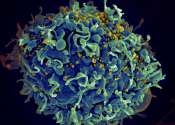
HIV

hide

Human immunodeficiency virus (HIV) is a lentivirus (a member of the retrovirus family) that causes acquired immunodeficiency syndrome (AIDS), a condition in humans in which the immune system begins to fail, leading to life-threatening opportunistic infections. Infection with HIV occurs by the transfer of blood, semen, vaginal fluid, pre-ejaculate, or breast milk. Within these bodily fluids, HIV is present as both free virus particles and virus within infected immune cells. The four major routes of transmission are unsafe sex, contaminated needles, breast milk, and transmission from an infected mother to her baby at birth (Vertical transmission). Screening of blood products for HIV has largely eliminated transmission through blood transfusions or infected blood products in the developed world.

HIV infection in humans is now pandemic. From 1981 to 2006, AIDS killed more than 25 million people. HIV infects about 0.6 percent of the world's population. In 2005 alone, AIDS claimed an estimated 2.4–3.3 million lives, of which more than 570,000 were children. A third of these deaths are occurring in sub-Saharan Africa, retarding economic growth and increasing poverty. According to current estimates, HIV is set to infect 90 million people in Africa, resulting in a minimum estimate of 18 million orphans. Antiretroviral treatment reduces both the mortality and the morbidity of HIV infection, but routine access to antiretroviral medication is not available in all countries.

HIV primarily infects vital cells in the human immune system such as helper T cells (specifically CD4+ T cells), macrophages, and dendritic cells. HIV infection leads to low levels of CD4+ T cells through three main mechanisms: firstly, direct viral killing of infected cells; secondly, increased rates of apoptosis in infected cells; and thirdly, killing of infected CD4+ T cells by CD8 cytotoxic lymphocytes that recognize infected cells. When CD4+ T cell numbers decline below a critical level, cell-mediated immunity is lost, and the body becomes progressively more susceptible to opportunistic infections.

Eventually most HIV-infected individuals develop AIDS. These individuals mostly die from opportunistic infections or malignancies associated with the progressive failure of the immune system. Without treatment, about 9 out of every 10 persons with HIV will progress to AIDS after 10–15 years. Many progress much sooner. Treatment with anti-retrovirals increases the life expectancy of people infected with HIV. Even after HIV has progressed to diagnosable AIDS, the average survival time with antiretroviral therapy (as of 2005) is estimated to be more than 5 years. Without antiretroviral therapy, death normally occurs within a year.

For more information about HIV, read the full article at Wikipedia.
This text uses material from Wikipedia and is available under the GNU Free Documentation License.


News tagged with human immunodeficiency virus

results timeline


Gene therapy technique slows brain disease

Gene therapy technique slows ALD brain disease

Medicine & Health / Research

created Nov 05, 2009 | popularity 5 / 5 (1) | comments 0

A strategy that combines gene therapy with blood stem cell therapy may be a useful tool for treating a fatal brain disease, French researchers have found. These findings appear in the 6 November 2009 issue ...


Taking medicine for HIV proves hard to swallow for many people

Medicine & Health / HIV & AIDS

created Oct 22, 2009 | popularity not rated yet | comments 0

Highly active antiretroviral therapy has increased the longevity and quality of life for people living with human immunodeficiency virus. But it requires strict adherence in taking the medicine, something that is extremely ...


AIDS: Are the wilderness years over for vaccine research?

Medicine & Health / HIV & AIDS

created Oct 21, 2009 | popularity 5 / 5 (1) | comments 0

Scientists looking for a vaccine against the AIDS virus can be forgiven for wondering at times whether they made the right career decision.


Researcher studies monkeys in Africa to better understand virus evolution

Medicine & Health / HIV & AIDS

created Oct 07, 2009 | popularity not rated yet | comments 0

(PhysOrg.com) -- Despite the importance of AIDS in human health, scientists still know very little about the diversity and ecology of AIDS-like viruses in nature.


New chemically-activated antigen could expedite development of HIV vaccine

Chemistry / Biochemistry

created Sep 21, 2009 | popularity not rated yet | comments 0

Scientists working to develop a vaccine for the human immunodeficiency virus (HIV) report they have created the first antigen that induces protective antibodies capable of blocking infection of human cells by genetically-diverse ...


Virus responsible for deadly brain disease found in MS patients treated with natalizumab

Medicine & Health / Diseases

created Sep 09, 2009 | popularity 4.5 / 5 (2) | comments 0

The virus responsible for PML (progressive multifocal leukoencephalopathy), a rare brain disease that typically affects AIDS patients and other individuals with compromised immune systems, has been found to be reactivated ...


Researchers find TB-prevention therapy is cost-effective option

Medicine & Health / Diseases

created Sep 09, 2009 | popularity not rated yet | comments 0

University of Alabama at Birmingham (UAB) researchers have found that the cost of preventive antibiotic tuberculosis (TB) therapy for patients infected by human immunodeficiency virus (HIV) is generally less expensive than ...


Engineered protein-like molecule protects cells against HIV infection

Medicine & Health / HIV & AIDS

created Aug 17, 2009 | popularity 5 / 5 (1) | comments 0

(PhysOrg.com) -- With the help of the human immunodeficiency virus (HIV) and molecular engineering, researchers have designed synthetic protein-like mimics convincing enough to interrupt unwanted biological conversations ...


An HIV-blocking gel for women

An HIV-blocking gel for women

Medicine & Health / HIV & AIDS

created Aug 10, 2009 | popularity not rated yet | comments 2

University of Utah scientists developed a new kind of "molecular condom" to protect women from AIDS in Africa and other impoverished areas. Before sex, women would insert a vaginal gel that turns semisolid ...


New invention could revolutionize how diseases are diagnosed

New invention could revolutionize how diseases are diagnosed

Technology / Engineering

created Jul 24, 2009 | popularity 4.5 / 5 (12) | comments 2

(PhysOrg.com) -- An award-winning invention by Stanford doctoral students Richard Gaster and Drew Hall may change who diagnoses diseases ranging from flu to the Human Immunodeficiency Virus. The invention, ...


HIV infection and chronic drinking have a synergistic, damaging effect on the brain

Medicine & Health / HIV & AIDS

created Jul 23, 2009 | popularity not rated yet | comments 0

More than half of clinic patients infected with the human immunodeficiency virus (HIV) report they also drink heavily. While highly active antiretroviral therapy has helped to reduce HIV-related cognitive and motor deficits, ...


New electron microscopy images reveal the assembly of HIV

New electron microscopy images reveal the assembly of HIV

Medicine & Health / HIV & AIDS

created Jun 23, 2009 | popularity 4.7 / 5 (3) | comments 0

Scientists at the European Molecular Biology Laboratory (EMBL) and the University Clinic Heidelberg, Germany, have produced a three-dimensional reconstruction of HIV (Human Immunodeficiency Virus), which shows ...


Adult circumcision reduces risk of HIV transmission without reducing sexual pleasure

Medicine & Health / HIV & AIDS

created Apr 26, 2009 | popularity 3.5 / 5 (4) | comments 2

Two studies presented at the 104th Annual Scientific Meeting of the American Urological Association (AUA) show that adult circumcision reduces the risk of contracting the human immunodeficiency virus (HIV) and the risk of ...


Caltech scientists show why anti-HIV antibodies are ineffective at blocking infection

Scientists show why anti-HIV antibodies are ineffective at blocking infection

Medicine & Health / HIV & AIDS

created Apr 22, 2009 | popularity 5 / 5 (8) | comments 2

Some 25 years after the AIDS epidemic spawned a worldwide search for an effective vaccine against the human immunodeficiency virus (HIV), progress in the field seems to have effectively become stalled. The ...


Potential new HIV drug may help patients not responding to treatment

Medicine & Health / HIV & AIDS

created Mar 31, 2009 | popularity not rated yet | comments 0

A potential treatment for HIV may one day help people who are not responding to Anti-Retroviral Therapy, suggests new research published tomorrow in The Journal of Immunology. Scientists looking at monkeys with the simian ...