Related topics: fruit flies


Insect

hide

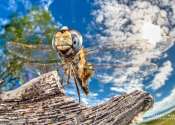
Insects (Class Insecta) are arthropods, having a hard exoskeleton, a three-part body (head, thorax, and abdomen), three pairs of jointed legs, compound eyes, and two antennae. They are the most diverse group of animals on the planet and include approximately 30 gladiator and icebug, 35 Zoraptera, 150 snakefly, 200 silverfish, 300 alderfly, 300 webspinner, 350 jumping bristletail, 550 scorpionfly, 600 Strepsiptera, 1,200 caddisfly, 1,700 stonefly, 1,800 earwig, 2,000 flea, 2,200 mantis, 2,500 mayfly, 3,000 louse, 3,000 walking stick, 4,000 cockroach, 4,000 lacewing, 4,000 termite, 5,000 dragonfly, 5,000 thrips, 5,500 booklouse, 20,000 cricket, grasshopper, and locust, 82,000 true bug, 110,000 ant, bee, sawfly, and wasp, 120,000 true fly, 170,000 butterfly and moth, and 360,000 beetle species described to date. The number of extant species is estimated at between six and ten million, with over a million species already described. Insects represent more than half of all known living organisms and potentially represent over 90% of the differing life forms on Earth. Insects may be found in nearly all environments, although only a small number of species occur in the oceans, a habitat dominated by another arthropod group, the crustaceans.

Adult modern insects range in size from a 0.139 mm (0.00547 in) fairyfly (Dicopomorpha echmepterygis) to a 56.7-centimetre (22.3 in) long stick insect (Phobaeticus chani). The heaviest documented present-day insect was 70 g (2½ oz) Giant Weta, though the Goliath beetles Goliathus goliatus, Goliathus regius and Cerambycid beetles such as Titanus giganteus hold the title for some of the largest species in general.

The largest known extinct insect is a kind of dragonfly, Meganeura.
For more information about Insect, read the full article at Wikipedia.
This text uses material from Wikipedia and is available under the GNU Free Documentation License.


News tagged with insects

results timeline


New research explains orchids' sexual trickery

Biology / Plants & Animals

created Dec 17, 2009 | popularity 4.8 / 5 (4) | comments 0

A new study reveals the reason why orchids use sexual trickery to lure insect pollinators. The study, published in the January issue of The American Naturalist, finds that sexual deception in orchids leads to a more effici ...


ARS Scientists Help Fight Damaging Moth in Africa

ARS Scientists Help Fight Damaging Moth in Africa

Biology / Ecology

created Dec 11, 2009 | popularity not rated yet | comments 0

(PhysOrg.com) -- Agricultural Research Service (ARS) scientists have launched a preemptive strike to combat the false codling moth, a major pest in its native Africa.


Experts: Disease-resistant plants enhance profits, client satisfaction

Experts: Disease-resistant plants enhance profits, client satisfaction

Biology / Ecology

created Dec 11, 2009 | popularity not rated yet | comments 0

New varieties of plants marketed as "disease-resistant" or "insect-resistant" are becoming more accessible to consumers. Available through local garden centers and catalogues, these attractive ornamentals ...


Flies like us: They can act like addicts, too

Biology / Cell & Microbiology

created Dec 10, 2009 | popularity 5 / 5 (1) | comments 0

When given the chance to consume alcohol at will, fruit flies behave in ways that look an awful lot like human alcoholism. That's according to a study published online on December 10th in Current Biology that is one of the ...


Charles Darwin: More than the origin

Charles Darwin: More than the origin

Biology / Evolution

created Dec 09, 2009 | popularity 5 / 5 (1) | comments 0

Although Charles Darwin is most well-known for his book On the Origin of Species, in which he described the process of natural selection, he greatly contributed to many specific fields within biology. As ...


MSU research may lead to new ways to control honeybee parasite

New research may lead to new ways to control honeybee parasite

Chemistry / Biochemistry

created Dec 08, 2009 | popularity 4.5 / 5 (4) | comments 0

(PhysOrg.com) -- Ground-breaking discoveries by Michigan State University researchers could help protect honeybees from deadly parasites that have devastated commercial colonies.


Caltech scientists discover aggression-promoting pheromone in flies

Scientists discover aggression-promoting pheromone in flies (w/ Video)

Biology / Plants & Animals

created Dec 06, 2009 | popularity 4 / 5 (10) | comments 1

Have you ever found yourself struggling to get your order taken at a crowded bar or lunch counter, only to walk away in disgust as more aggressive customers elbow their way to the front? It turns out that ...


Researchers discover how a brain hormone controls insect metamorphosis

Biology / Cell & Microbiology

created Dec 03, 2009 | popularity 5 / 5 (2) | comments 0

A team of University of Minnesota researchers have discovered how PTTH, a hormone produced by the brain, controls the metamorphosis of juvenile insects into adults.


ARS Survey Helps Growers Track Two Key Cotton Pests

ARS Survey Helps Growers Track Two Key Cotton Pests

Biology / Ecology

created Dec 01, 2009 | popularity not rated yet | comments 0

(PhysOrg.com) -- Cotton growers will be better able to keep an eye out for two common pests because of a comprehensive survey by Agricultural Research Service (ARS) scientists at College Station, Texas.


Immunity-Related Genes in Leafcutting Bee Uncovered

Immunity-Related Genes in Leafcutting Bee Uncovered

Biology / Plants & Animals

created Nov 30, 2009 | popularity not rated yet | comments 0

(PhysOrg.com) -- The first analysis of immunity-related genes in a solitary bee has been conducted by Agricultural Research Service (ARS) scientists and cooperators.


Whiteflies sabotage alarm system of plant in distress

Whiteflies sabotage alarm system of plant in distress

Biology / Plants & Animals

created Nov 26, 2009 | popularity 5 / 5 (3) | comments 0

(PhysOrg.com) -- When spider mites attack a bean plant, the plant responds by producing odours which attract predatory mites. These predatory mites then exterminate the spider mite population, thus acting ...


Variable Temperatures Leave Insects wtih a Frosty Reception

Biology / Plants & Animals

created Nov 25, 2009 | popularity 4 / 5 (1) | comments 0

(PhysOrg.com) -- For the first time, scientists at The University of Western Ontario have shown that insects exposed to repeated periods of cold will trade reproduction for immediate survival.


Ice Cold: Cooler Than Being Cool

Ice Cold: Cooler Than Being Cool

Biology / Cell & Microbiology

created Nov 24, 2009 | popularity 4.2 / 5 (10) | comments 0

(PhysOrg.com) -- Water expands when it freezes. Anyone who has ever left a can of soda or bottle of water in the freezer too long has witnessed this first hand. So how do plants and animals survive severe ...


Spider secrets decoded in world-first database

Biology / Plants & Animals

created Nov 23, 2009 | popularity not rated yet | comments 0

(PhysOrg.com) -- Queensland scientists have developed a world-first database that catalogues the venom components from hundreds of spiders.


Insect resistance to Bt crops can be predicted, monitored and managed

Biology / Ecology

created Nov 23, 2009 | popularity not rated yet | comments 0

Since 1996, crop plants genetically modified to produce bacterial proteins that are toxic to certain insects, yet safe for people, have been planted on more than 200 million hectares worldwide. The popularity of these Bt ...