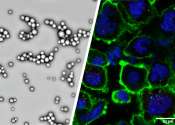
Malignancy
hideMalignancy (from the Latin roots mal- = "bad" and -genus = "born") is the tendency of a medical condition, especially tumors to become progressively worse and to potentially result in death. It is characterized by the properties of anaplasia, invasiveness, and metastasis. Malignant is a corresponding adjectival medical term used to describe a severe and progressively worsening disease. The term is most familiar as a description of cancer. A malignant tumor may be contrasted with a non-cancerous benign tumor in that a malignancy is not self-limited in its growth, is capable of invading into adjacent tissues, and may be capable of spreading to distant tissues (metastasizing), while a benign tumor has none of those properties. Malignant tumor is synonymous with cancer. Uses of "malignant" in oncology:
Non-oncologic disorders referred to as "malignant":
For more information about Malignancy, read the full article at
Wikipedia.
This text uses material from Wikipedia and is available under the GNU Free Documentation License.
News tagged with malignant cell
Fat droplet nanoparticle delivers tumor suppressor gene to tumor and metastatic cells
Nanotechnology / Bio & Medicine
Apr 20, 2009 |
5 / 5 (3) |
0
Dr. Esther Chang describes the most recent developments in human trials of the first systemic, non-viral, tumor-targeted, nanoparticle method designed to restore normal gene function to tumor cells while completely bypassing ...
Twin nanoparticle shown effective at targeting, killing breast cancer cells
Nanotechnology / Bio & Medicine
Mar 10, 2009 |
5 / 5 (2) |
1
Breast cancer patients face many horrors, including those that arise when fighting the cancer itself. Medications given during chemotherapy can have wicked side effects, including vomiting, dizziness, anemia ...
Search results for malignant cell
Net widens as more proteins implicated in cancer spread
Oct 02, 2008 |
5 / 5 (3) |
0
(PhysOrg.com) -- Authorities are on the lookout for 64 proteins believed to have been talking to well-known cancer kingpin urokinase plasminogen activator receptor (a.k.a uPAR).
Melanosome dynamics and sensitivity of melanoma cells to chemotherapy
Aug 25, 2009 |
not rated yet |
0
Manipulating the functions of melanosomes--the organelles in pigment-producing cells--may enhance the activity of anticancer drugs used against melanoma, according to a new study published online August 24 in the Journal of ...
Is it possible to differentiate GISTs from leiomyomas by endoscopic ultrasonography?
Jul 29, 2009 |
4 / 5 (1) |
0
A research article to be published on July 21, 2009 in the World Journal of Gastroenterology addresses this question. This research led by Professor Kim and his colleagues in Pusan National University, South Korea. They e ...
Research isolates liver cancer stem cells prior to tumor formation
Sep 17, 2009 |
5 / 5 (1) |
0
Penn State College of Medicine researchers, in collaboration with colleagues at the University of Southern California, have taken an important step in understanding the role of stem cells in development of liver cancer. Using ...
Rearrangements of multifunctional genes cause cancer in children and young people
Mar 10, 2009 |
4 / 5 (1) |
0
A doctoral thesis presented at the Sahlgrenska Academy, University of Gothenburg, Sweden, shows that three genes that lie behind a number of malignant tumour diseases are normally involved in several fundamental processes ...
Loss of tumor supressor gene essential to transforming benign nerve tumors into cancers
Oct 13, 2009 |
4 / 5 (1) |
0
Researchers at UCLA's Jonsson Comprehensive Cancer Center showed for the first time that the loss or decreased expression of the tumor suppressor gene PTEN plays a central role in the malignant transformation of benign nerve ...
Mechanism in cells that generate malignant brain tumors may offer target for gene therapy
Oct 24, 2008 |
4.5 / 5 (2) |
0
Researchers at Cedars-Sinai Medical Center's Maxine Dunitz Neurosurgical Institute who first isolated cancer stem cells in adult brain tumors in 2004 have now identified a molecular mechanism that is involved in the development ...
Do patients at risk for B-cell malignancy need antiviral treatment?
Apr 15, 2009 |
not rated yet |
0
Some studies have shown that a relationship of hepatitis C (HCV) infection with type II mixed cryoglobulinemia exists. However the precise mechanism remains unclear.
A Viral Cause of Prostate Cancer?
Sep 07, 2009 |
4.7 / 5 (3) |
1
(PhysOrg.com) -- In a finding with potentially major implications for identifying a viral cause of prostate cancer, researchers at the University of Utah and Columbia University medical schools have reported ...
Mapping of prostate cancer genes opens the door to new treatments
May 20, 2008 |
4.3 / 5 (6) |
1
Genetic changes during the initiation and progression of prostate cancer have eluded scientists to date. Now for the first time researchers have identified a specific gene expression profile of prostate cancer stem cells, ...
List of search results for malignant cell


