News tagged with mycobacteria
Study uncovers evidence on how drug-resistant tuberculosis cells form
A new study led by Harvard School of Public (HSPH) researchers provides a novel explanation as to why some tuberculosis cells are inherently more difficult to treat with antibiotics. The discovery, which showed that the ways ...
Dec 15, 2011 |
not rated yet |
0
|
How mycobacteria avoid destruction inside human cells
Tuberculosis, or TB, is a dreaded contagious disease of the lungs and other organs. The causative agent, Mycobacterium tuberculosis (or M. tuberculosis), infects roughly a third of the world's population and one-in-ten to ...
Sep 09, 2010 |
not rated yet |
0
Research targets basic metabolism of disease-causing fungi, bacteria
Pablo Sobrado, assistant professor of biochemistry with the Fralin Life Science Institute at Virginia Tech, has received a $1.1 million grant from the National Science Foundation (NSF) to advance his research on the mechanism ...
Aug 18, 2010 |
3 / 5 (1) |
0
Dairy farmers can fight growing disease threat with chlorine and stainless steel
Two good tips for preventing Johne's disease on dairy farms: Use stainless steel water troughs and add chlorine to the water. That's according to Kim Cook, an Agricultural Research Service (ARS) microbiologist at the agency's ...
Jul 20, 2010 |
not rated yet |
0
Researchers discover gene that affects susceptibility to TB and clues to how it works
University of Washington (UW) researchers have identified a gene involved in susceptibility and resistance to tuberculosis. This same gene, they have found, has a role in the severity of leprosy, which is ...
Mar 04, 2010 |
5 / 5 (2) |
0
|
Genetic variant offers protection against TB and leprosy
A study into why some people are more resistant than others to diseases such as tuberculosis (TB) and leprosy has identified a new genetic variant which affects susceptibility to these diseases. The findings, published today ...
Mar 04, 2010 |
5 / 5 (1) |
0
How clean is your knife?
A new fast-acting disinfectant that is effective against bacteria, viruses, fungi and prions could help to reduce the spread of deadly infections in hospitals, according to research published in the February issue of Journal of ...
Jan 20, 2010 |
3 / 5 (2) |
0
Mutation leads to new and severe form of bacterial disease
(PhysOrg.com) -- Everybody gets sick, but how sick you get is in your genes. New research now reveals a mutation on a gene that makes children susceptible to a severe form of mycobacterial disease. The work not only supports ...
Dec 18, 2009 |
not rated yet |
0
Captive turtle found to have infectious disease
An Australian veterinary student said Monday she has documented the country's first known case of a bred-in-captivity turtle acquiring a highly infectious disease which could potentially spread to humans.
Oct 05, 2009 |
5 / 5 (1) |
0
Genome sequencing reveals genetic diversity of the bacteria that cause Buruli ulcer
A new study lays the groundwork for development of a cost-effective tool for studying the population structure and spread of Mycobacterium ulcerans, the causative agent of Buruli ulcer. Researchers at the Swiss Tropical Instit ...
Sep 11, 2009 |
not rated yet |
0
Toward an explanation for Crohn's disease?
Twenty-five per cent of Crohn's disease patients have a mutation in what is called the NOD2 gene, but it is not precisely known how this mutation influences the disease. The latest study by Dr. Marcel Behr, of the Research ...
Jul 09, 2009 |
not rated yet |
0
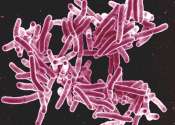
Mycobacterium
Mycobacterium is a genus of Actinobacteria, given its own family, the Mycobacteriaceae. The genus includes pathogens known to cause serious diseases in mammals, including tuberculosis (Mycobacterium tuberculosis) and leprosy (Mycobacterium leprae). The Greek prefix "myco—" means fungus, alluding to the way mycobacteria have been observed to grow in a mould-like fashion on the surface of liquids when cultured.
For more information about Mycobacterium, read the full article at
Wikipedia.
This text uses material from Wikipedia and is available under the GNU Free Documentation License.