Related topics: stars


Planet

hide

A planet (from Greek πλανήτης, from the verb πλανώμαι planōmai I wander), is a celestial body orbiting a star or stellar remnant that is massive enough to be rounded by its own gravity, is not massive enough to cause thermonuclear fusion, and has cleared its neighbouring region of planetesimals.[a]

The term planet is ancient, with ties to history, science, myth, and religion. The planets were originally seen by many early cultures as divine, or as emissaries of the gods. Even today, many people believe in astrology, which holds that the movement of the planets affects people's lives, although such a causation is rejected by the scientific community. As scientific knowledge advanced, human perception of the planets changed, incorporating a number of disparate objects. Even now there is no uncontested definition of what a planet is. In 2006, the IAU officially adopted a resolution defining planets within the Solar System. This definition has been both praised and criticized, and remains disputed by some scientists.

The planets were thought by Ptolemy to orbit the Earth in deferent and epicycle motions. Though the idea that the planets orbited the Sun had been suggested many times, it was not until the 17th century that this view was supported by evidence from the first telescopic astronomical observations, performed by Galileo Galilei. By careful analysis of the observation data, Johannes Kepler found the planets' orbits to be not circular, but elliptical. As observational tools improved, astronomers saw that, like Earth, the planets rotated around tilted axes, and some share such features as ice-caps and seasons. Since the dawn of the Space Age, close observation by probes has found that Earth and the other planets share characteristics such as volcanism, hurricanes, tectonics, and even hydrology. Since 1992, through the discovery of hundreds of extrasolar planets (planets around other stars), scientists are beginning to understand that planets throughout the Milky Way Galaxy share characteristics in common with our own.

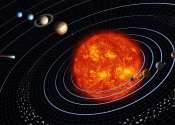
Planets are generally divided into two main types: large, low-density gas giants, and smaller, rocky terrestrials. Under IAU definitions, there are eight planets in the Solar System. In order from the Sun, they are the four terrestrials, Mercury, Venus, Earth, and Mars, then the four gas giants, Jupiter, Saturn, Uranus, and Neptune. The Solar System also contains at least five dwarf planets: Ceres, Pluto (originally classified as the Solar System's ninth planet), Makemake, Haumea and Eris. With the exception of Mercury, Venus, Ceres and Makemake, all of these are orbited by one or more natural satellites.

As of June 2009, there are 353 known extrasolar planets, ranging from the size of gas giants to that of terrestrial planets.

For more information about Planet, read the full article at Wikipedia.
This text uses material from Wikipedia and is available under the GNU Free Documentation License.


News tagged with planets

results timeline


Planet 51 Star Brings NASA's Message of Exploration Down to Earth

Space & Earth / Space Exploration

created Nov 20, 2009 | popularity 4 / 5 (2) | comments 0

(PhysOrg.com) -- Actor Dwayne Johnson, usually known for his action and comedic film roles, takes to the stars as an astronaut in a new animated feature that brings important messages about the importance of space exploration ...


Hunting for Planets in the Dark

Hunting for Planets in the Dark

Space & Earth / Astronomy

created Nov 19, 2009 | popularity 4.7 / 5 (3) | comments 3

A proposed space mission that aims to measure dark energy could also detect planets that current surveys are unable to find.


Subaru Telescope Spots Strange Spin

Discovery of a Retrograde or Highly Tilted Extrasolar Planet

Space & Earth / Astronomy

created Nov 18, 2009 | popularity 4.8 / 5 (5) | comments 1

Astronomers have found that the extrasolar planet HAT-P-7b has a retrograde or highly tilted orbit. Studying such planets is important in understanding the diversity of planetary systems and assessing current ...


Dawn Enters Asteroid Belt -- For Good

Dawn Enters Asteroid Belt -- For Good

Space & Earth / Space Exploration

created Nov 16, 2009 | popularity 4.7 / 5 (7) | comments 0

(PhysOrg.com) -- NASA's Dawn spacecraft re-entered our solar system's asteroid belt today, Nov. 13, and this time it will stay there.


Exoplanets Clue to Sun's Curious Chemistry

Exoplanets Clue to Sun's Curious Chemistry

Space & Earth / Astronomy

created Nov 11, 2009 | popularity 4.6 / 5 (20) | comments 15

(PhysOrg.com) -- A ground-breaking census of 500 stars, 70 of which are known to host planets, has successfully linked the long-standing "lithium mystery" observed in the Sun to the presence of planetary systems. ...


L-R: Chiwetel Ejiofor, Amanda Peet and John Cusack at the premiere of "2012"

NASA on crusade to debunk 2012 apocalypse myths

Space & Earth / Space Exploration

created Nov 09, 2009 | popularity 4.9 / 5 (7) | comments 4

The world is not coming to an end on December 21, 2012, the US space agency insisted Monday in a rare campaign to dispel widespread rumors fueled by the Internet and a new Hollywood movie.


Starring Intelligent Aliens

Starring Intelligent Aliens

Space & Earth / Astronomy

created Nov 05, 2009 | popularity 4.7 / 5 (9) | comments 7

The most probable place to find intelligent life in the galaxy is around stars very similar to our sun, a new study has found.


Unsettled Youth: Spitzer Observes a Chaotic Planetary System

Unsettled Youth: Spitzer Observes a Chaotic Planetary System

Space & Earth / Astronomy

created Nov 04, 2009 | popularity 4.1 / 5 (7) | comments 0

(PhysOrg.com) -- Before our planets found their way to the stable orbits they circle in today, they wiggled and jostled about like unsettled children. Now, NASA's Spitzer Space Telescope has found a young ...


Icebreaker: Scientist brings out the big gun to explore the behavior of ice in planetary collisions

Icebreaker: Scientist brings out big gun to explore behavior of ice in planetary collisions

Space & Earth / Space Exploration

created Oct 29, 2009 | popularity not rated yet | comments 0

(PhysOrg.com) -- Every month, Sarah Stewart-Mukhopadhyay fires her 20-foot gun in the basement of Harvard's Hoffman Lab, sending shivers through the concrete and steel structure that can be picked up by seismometers ...


Detecting Life-Friendly Moons

Detecting Life-Friendly Moons

Space & Earth / Space Exploration

created Oct 26, 2009 | popularity 4.8 / 5 (11) | comments 3

The search for life-friendly real estate around distant stars doesn't have to be limited to planets. New research shows that habitable exomoons can be detected with a new method using current technology.


Building Planet Earth

Building Planet Earth

Space & Earth / Astronomy

created Oct 22, 2009 | popularity 4.4 / 5 (9) | comments 1

A new study shows how rocky planets are formed from the manic swirl of gas and dust that surround a young star, and determines what chemical building blocks are used to construct the planets. Understanding ...


Astronomers do it Again: Find Organic Molecules Around Gas Planet

Astronomers do it Again: Find Organic Molecules Around Gas Planet (w/ Video)

Space & Earth / Astronomy

created Oct 20, 2009 | popularity 4.6 / 5 (16) | comments 8

(PhysOrg.com) -- Peering far beyond our solar system, NASA researchers have detected the basic chemistry for life in a second hot gas planet, advancing astronomers toward the goal of being able to characterize ...


The system Gliese 667 (Artist’s impression)

32 New Exoplanets Found (w/ Video)

Space & Earth / Astronomy

created Oct 19, 2009 | popularity 4.9 / 5 (27) | comments 6

(PhysOrg.com) -- Today, at an international ESO/CAUP exoplanet conference in Porto, the team who built the High Accuracy Radial Velocity Planet Searcher, better known as HARPS, the spectrograph for ESO's 3.6-metre ...


Dirty stars make good solar system hosts (w/ Video)

Space & Earth / Astronomy

created Oct 06, 2009 | popularity 4.6 / 5 (7) | comments 1

Some stars are lonely behemoths, with no surrounding planets or asteroids, while others sport a skirt of attendant planetary bodies. New research published this week in The Astrophysical Journal Letters explains why the co ...


The Hot Saturn Exoplanet

The Hot Saturn Exoplanet

Space & Earth / Astronomy

created Oct 02, 2009 | popularity 4.4 / 5 (11) | comments 3

(PhysOrg.com) -- Of the roughly 350 known exoplanets (i.e., extrasolar planets), the one orbiting the star HD149026 is unique.