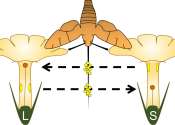
Pollinator
hideA pollinator is the biotic agent (vector) that moves pollen from the male anthers of a flower to the female stigma of a flower to accomplish fertilization or syngamy of the female gamete in the ovule of the flower by the male gamete from the pollen grain. Though the terms are sometimes confused, a pollinator is different from a pollenizer, which is a plant that is a source of pollen for the pollination process.
For more information about Pollinator, read the full article at
Wikipedia.
This text uses material from Wikipedia and is available under the GNU Free Documentation License.
News tagged with pollinators
The evolution of orchids
Nov 19, 2009 |
4.8 / 5 (8) |
4
(PhysOrg.com) -- Charles Darwin and many other scientists have long been puzzled by the evolution of orchids, the largest and most diverse family of flowering plants on Earth. Now genetic sequencing is giving ...
Scientists examine how common pesticide mixes may affect bee die-offs
Oct 29, 2009 |
not rated yet |
0
(PhysOrg.com) -- Since reports of widespread bee die-offs began to surface in October 2006, researchers have investigated possible reasons ranging from hive-infecting mites to cell phone-tower radiation. They have yet to ...
Penn State researchers promote pollinator-friendly native gardens
Oct 19, 2009 |
5 / 5 (1) |
0
(PhysOrg.com) -- Across the country, pollinators such as honeybees and hummingbirds are declining due to habitat loss, diseases such as Colony Collapse Disorder (CCD), pests and excessive pesticide use. Penn ...
Killer bees may increase food supplies for native bees
Oct 01, 2009 |
not rated yet |
0
Aggressive African bees were accidentally released in Brazil in 1957. As "killer bees" spread northward, David Roubik, staff scientist at the Smithsonian Tropical Research Institute, began a 17-year study ...
Bumblebees dive in to fill a void
Sep 02, 2009 |
4 / 5 (1) |
0
Native pollinators such as these fat, fuzzy bumblebees, once an overlooked sideshow in the insect world, are gaining widespread appreciation among everyone from backyard gardeners to big-time farmers. That's because European ...
Bats without borders: World's largest bats need international protection
Aug 25, 2009 |
not rated yet |
0
Without at least a temporary reprieve from hunting, the world's largest species of fruit bat, Pteropus vampyrus or the "large flying fox", could be driven to extinction in Peninsular Malaysia at the current hunting rate, ...
New orchid deception found: wearing the scent of hornet's prey
Aug 06, 2009 |
not rated yet |
0
Orchids are famous for their deceptions. Most of those with nothing of value to offer their pollinators lure them instead with the scents of more rewarding flowers or potential mates. Now, a report published online on August ...
Honeybees overcome negative buzz in Washington
Jun 23, 2009 |
not rated yet |
1
Official Washington is all abuzz over honeybees.
Franklin's bumble bee may be extinct
May 26, 2009 |
4.8 / 5 (6) |
5
(PhysOrg.com) -- Native pollinator specialist Robbin Thorp, emeritus professor of entomology at the University of California, Davis, just returned from a scientific trip to southern Oregon and Northern California ...
Honeybees are on the rise but demand grows faster
May 07, 2009 |
4 / 5 (2) |
1
The notion that a decline in pollinators may threaten the human food supply - producing a situation that has been referred to as a "pollination crisis" - can be considered a myth, at least where honey bees ...
When industrious ants go too far
Apr 28, 2009 |
3.5 / 5 (4) |
0
Nature is full of mutually beneficial arrangements between organisms—like the relationship between flowering plants and their bee pollinators. But sometimes these blissful relationships have a dark side, as Harvard biologist ...
Honeybees not fooled by cheating flowers
Apr 15, 2009 |
3.3 / 5 (3) |
0
(PhysOrg.com) -- Flowers that want to cheat pollinators by not paying them for their services shouldn’t try to lure them in using floral scents, scientists at Newcastle University have shown.
Male flower parts responsible for potent grapevine perfume
Apr 06, 2009 |
not rated yet |
0
University of British Columbia scientists have traced the fragrant scent of grapevine flowers to pollen grains stored in the anthers, contrary to common perception that petals alone produce perfume.
Flight of the bumble (and honey) bee
Mar 20, 2009 |
5 / 5 (2) |
0
Insects such as honeybees and bumble bees are predictable in the way they move among flowers, typically moving directly from one flower to an adjacent cluster of flowers in the same row of plants. The bees' ...
Bees attracted by floral iridescence
Biology /
Jan 09, 2009 |
4.7 / 5 (6) |
1
(PhysOrg.com) -- Plants and their pollinators are the focus of ground-breaking research by Dr Heather Whitney, recently appointed Lloyds Fellow in the School of Biological Sciences. Her latest work, carried ...