Quantum
hideIn physics, a quantum (plural: quanta) is an indivisible entity of a quantity that has the same units as the Planck constant and is related to both energy and momentum of elementary particles of matter (called fermions) and of photons and other bosons. The word comes from the Latin "quantus", for "how much." Behind this, one finds the fundamental notion that a physical property may be "quantized", referred to as "quantization". This means that the magnitude can take on only certain discrete numerical values, rather than any value, at least within a range. There is a related term of quantum number.
A photon is often referred to as a "light quantum". The energy of an electron bound to an atom (at rest) is said to be quantized, which results in the stability of atoms, and of matter in general. But these terms can be a little misleading, because what is quantized is this Planck's constant quantity whose units can be viewed as either energy multiplied by time or momentum multiplied by distance.
Usually referred to as quantum "mechanics", it is regarded by virtually every professional physicist as the most fundamental framework we have for understanding and describing nature at the infinitesimal level, for the very practical reason that it works. It is "in the nature of things", not a more or less arbitrary human preference.
For more information about Quantum, read the full article at
Wikipedia.
This text uses material from Wikipedia and is available under the GNU Free Documentation License.
News tagged with quantum
Quantum gas microscope offers glimpse of quirky ultracold atoms
Nov 04, 2009 |
4.6 / 5 (15) |
4
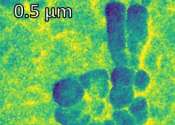
(PhysOrg.com) -- Physicists at Harvard University have created a quantum gas microscope that can be used to observe single atoms at temperatures so low the particles follow the rules of quantum mechanics, ...
Creating a six-qubit cluster state
Nov 02, 2009 |
4.6 / 5 (10) |
2
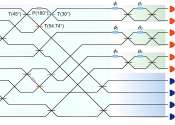
(PhysOrg.com) -- Many scientists believe that quantum entanglement is required in order for effective quantum computing. Entanglement takes place when there is a connection that exists between two objects - even when they ...
Research continues on secure, mobile, quantum communications
Oct 27, 2009 |
5 / 5 (2) |
0
Researcher Dr. David H. Hughes of the Air Force Research Laboratory in Rome, N.Y. is leading a team investigating long-distance, mobile optical links imperative for secure quantum communications capabilities in theater.
Researchers create all-electric spintronics
Oct 27, 2009 |
4.9 / 5 (19) |
3
A multidisciplinary team of UC researchers is the first to find an innovative and novel way to control an electron's spin orientation using purely electrical means.
Study Shows Time Traveling May Not Increase Computational Power
Oct 22, 2009 |
4.1 / 5 (26) |
5
(PhysOrg.com) -- For more than 50 years, physicists have been intrigued by the concept of closed time-like curves (CTCs). Because a CTC returns to its starting point, it raises the possibility of traveling backward in time. ...
The Spin Cycle: Nanoresearch could lead to next generation of transistors
Oct 20, 2009 |
4.9 / 5 (11) |
0
(PhysOrg.com) -- For decades, the transistors inside radios, televisions and other everyday items have transmitted data by controlling the movement of the electron’s charge. Scientists now have discovered ...
Company Introduces Novel Nanotechnology for Revolutionizing Imaging Using T-rays
Oct 20, 2009 |
4.3 / 5 (6) |
0
Yissum Research Development Company of the Hebrew University of Jerusalem today announced that Professor L.D. Shvartsman and Professor B. Laikhtman, from the Racah Institute of Physics at the Hebrew University of Jerusalem, ...
3 Questions: Steven Nahn on the elusive Higgs boson
Oct 19, 2009 |
4.3 / 5 (39) |
10
(PhysOrg.com) -- Troubles at the Large Hadron Collider have led some physicists to suggest the Higgs boson is sabotaging its own discovery. Nahn explains why he disagrees.
Physicists Calculate Number of Parallel Universes
Oct 16, 2009 |
3.1 / 5 (77) |
58
(PhysOrg.com) -- Over the past few decades, the idea that our universe could be one of many alternate universes within a giant multiverse has grown from a sci-fi fantasy into a legitimate theoretical possibility. ...
Physicist wins Packard Fellowship
Oct 16, 2009 |
1 / 5 (2) |
0
(PhysOrg.com) -- MIT physicist Pablo Jarillo-Herrero has won a 2009 David and Lucile Packard Fellowship, an award he will use to study a new class of materials that could have applications in the semiconductor ...
Field experiment on a robust hierarchical metropolitan quantum cryptography network
Oct 16, 2009 |
5 / 5 (1) |
0
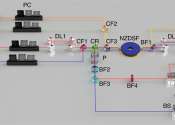
Key Laboratory of Quantum Information (CAS), University of Science and Technology of China has recently demonstrated a metropolitan Quantum Cryptography Network (QCN) for Government Administration in Wuhu, China. The project ...
Quantum Computer Chips Now One Step Closer To Reality
Oct 15, 2009 |
4.6 / 5 (16) |
0
In the quest for smaller, faster computer chips, researchers are increasingly turning to quantum mechanics -- the exotic physics of the small. The problem: the manufacturing techniques required to make quantum devices have ...
Quantum-limited Measurement Method for Nanosensors
Oct 14, 2009 |
4.3 / 5 (4) |
0
(PhysOrg.com) -- (PhysOrg.com) -- A team of scientists from the Max Planck Institute of Quantum Optics and the Ludwig Maximilians University have succeeded in applying a novel optical method to nano-mechanical ...
Computers Faster Only for 75 More Years? Physicists determine nature's limit to making faster processors
Oct 14, 2009 |
4.3 / 5 (26) |
32
With the speed of computers so regularly seeing dramatic increases in their processing speed, it seems that it shouldn't be too long before the machines become infinitely fast -- except they can't.
Scientists use math modeling to predict unknown biological mechanism of regulation
Oct 14, 2009 |
4.5 / 5 (4) |
0
A team of scientists, led by a biomedical engineer at The University of Texas at Austin, have demonstrated - for the first time - that mathematical models created from data obtained by DNA microarrays, can ...