Cicada-palooza! Billions of bugs to blanket America
They're loud. They're sexually aroused. And for one special, cacophonous month up to a trillion of them will engulf suburbs and woodlands across America.
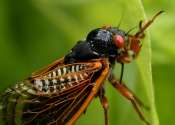
They're loud. They're sexually aroused. And for one special, cacophonous month up to a trillion of them will engulf suburbs and woodlands across America.
Ecology
Apr 27, 2024
0
80

When I first wrote about geoengineering in 2012 , it was considered far-fetched at best, and crazy by most. But 12 years later, while there is still controversy and considerable resistance to deploying it, respectable scientists ...
Environment
Apr 25, 2024
0
25
European astronomers have investigated a recently detected black hole designated Gaia BH3. In their results, they found that the black hole is associated with a nearby disrupted star cluster known as ED-2. The finding is ...

Transparent solar cells will transform the look of infrastructure by enabling many more surfaces to become solar panels. Now, materials called non-fullerene acceptors that can intrinsically generate charges when exposed to ...
Condensed Matter
Apr 24, 2024
0
29

A new study, led by the University of Oxford and MIT, has recovered a 3.7-billion-year-old record of Earth's magnetic field, and found that it appears remarkably similar to the field surrounding Earth today. The findings ...
Planetary Sciences
Apr 24, 2024
1
142

Japan's first moon lander has survived a third freezing lunar night, Japan's space agency said Wednesday after receiving an image from the device three months after it landed on the moon.
Space Exploration
Apr 24, 2024
0
592

Early results from a study of the April 8 total solar eclipse show a more noticeable effect on bird behavior than during the last eclipse.
Plants & Animals
Apr 23, 2024
0
24

In celebration of the 34th anniversary of the launch of NASA's legendary Hubble Space Telescope on April 24, astronomers took a snapshot of the Little Dumbbell Nebula (also known as Messier 76, M76, or NGC 650/651) located ...
Astronomy
Apr 23, 2024
0
87

When talk turns to climate change, certain images pop to mind—maybe polar bears on ever-shrinking ice floes, coral reefs drained of color, or more powerful hurricanes hitting the coast.
Environment
Apr 23, 2024
0
18

Photoelectrochemical processes have been considered sustainable alternatives for the remediation of water contaminated by domestic or industrial effluents. Simply put, the strategy consists of using solar energy to degrade ...
Analytical Chemistry
Apr 23, 2024
0
0
The Solar System[a] consists of the Sun and those celestial objects bound to it by gravity, all of which formed from the collapse of a giant molecular cloud approximately 4.6 billion years ago. The Sun's retinue of objects circle it in a nearly flat disc called the ecliptic plane, most of the mass of which is contained within eight relatively solitary planets whose orbits are almost circular. The four smaller inner planets; Mercury, Venus, Earth and Mars, also called the terrestrial planets, are primarily composed of rock and metal. The four outer planets, Jupiter, Saturn, Uranus and Neptune, also called the gas giants, are composed largely of hydrogen and helium and are far more massive than the terrestrials.
The Solar System is also home to two main belts of small bodies. The asteroid belt, which lies between Mars and Jupiter, is similar to the terrestrial planets as it is composed mainly of rock and metal. The Kuiper belt (and its subpopulation, the scattered disc), which lies beyond Neptune's orbit, is composed mostly of ices such as water, ammonia and methane. Within these belts, five individual objects, Ceres, Pluto, Haumea, Makemake and Eris, are recognised to be large enough to have been rounded by their own gravity, and are thus termed dwarf planets. The hypothetical Oort cloud, which acts as the source for long-period comets, may also exist at a distance roughly a thousand times beyond these regions.
Within the Solar System, various populations of small bodies, such as comets, centaurs and interplanetary dust, freely travel between these regions, while the solar wind, a flow of plasma from the Sun, creates a bubble in the interstellar medium known as the heliosphere, which extends out to the edge of the scattered disc.
Six of the planets and three of the dwarf planets are orbited by natural satellites, usually termed "moons" after Earth's Moon. Each of the outer planets is encircled by planetary rings of dust and other particles.
This text uses material from Wikipedia, licensed under CC BY-SA
