Frontpage » Tag » supernovae

News tagged with supernovae

Physicists push for underground testing facility

Pran Nath, the Matthews Distinguished Professor of Physics at Northeastern University, is among a group of leading theoretical physicists who have asked the Department of Energy to develop a large underground ...

Physics / General Physics

created Feb 02, 2012 | popularity 4.6 / 5 (5) | comments 12

Remnant of an explosion with a powerful kick?

(PhysOrg.com) -- Vital clues about the devastating ends to the lives of massive stars can be found by studying the aftermath of their explosions. In its more than twelve years of science operations, NASA's ...

Space & Earth / Astronomy

created Feb 02, 2012 | popularity not rated yet | comments 1 | with audio podcast

The chemistry of exploding stars

(PhysOrg.com) -- Fundamental chemical processes in predecessors of our solar system are now a bit better understood: An international team led by Peter Hoppe, researcher at the Max Planck Institute for Chemistry ...

Space & Earth / Astronomy

created Jan 20, 2012 | popularity 4.4 / 5 (10) | comments 4 | with audio podcast

Hubble breaks new ground with discovery of distant exploding star

NASA's Hubble Space Telescope has looked deep into the distant universe and detected the feeble glow of a star that exploded more than 9 billion years ago. The sighting is the first finding of an ambitious ...

Space & Earth / Astronomy

created Jan 11, 2012 | popularity 5 / 5 (3) | comments 0

Origin of thermonuclear supernova discovered

(PhysOrg.com) -- Using NASA’s Hubble Space Telescope, astronomers have solved a longstanding mystery on the type of star, or so-called progenitor, which caused a supernova seen in a nearby galaxy. The ...

Space & Earth / Astronomy

created Jan 11, 2012 | popularity 5 / 5 (3) | comments 4 | with audio podcast

Earliest-yet observation of August SN2011fe supernova nails it: Destroyed star was white dwarf

Last year's discovery of the nearest Type Ia supernova in decades – captured only 11 hours after it exploded – allowed astronomers to finally cinch the identity of the stars behind these explosions, which have become ...

Space & Earth / Astronomy

created Jan 11, 2012 | popularity 4.9 / 5 (7) | comments 7 | with audio podcast

Stars pop onto the scene in new WISE image

(PhysOrg.com) -- This enormous section of the Milky Way galaxy is a mosaic of images from NASA's Wide-field Infrared Survey Explorer, or WISE. The constellations Cassiopeia and Cepheus are featured in this ...

Space & Earth / Astronomy

created Jan 10, 2012 | popularity 5 / 5 (4) | comments 2

Fermi telescope explores new energy extremes

(PhysOrg.com) -- After more than three years in space, NASA's Fermi Gamma-ray Space Telescope is extending its view of the high-energy sky into a largely unexplored electromagnetic range. Today, the Fermi ...

Space & Earth / Astronomy

created Jan 10, 2012 | popularity 4.9 / 5 (17) | comments 0 | with audio podcast

Stellar discovery

On August 24, astrophysicist Peter Nugent was playing a little catch-up. Nugent, an adjunct professor at Berkeley and group leader of the Computational Cosmology Center at Lawrence Berkeley National Laboratory, ...

Space & Earth / Astronomy

created Jan 04, 2012 | popularity 4.9 / 5 (8) | comments 3

Space Image: Fastest rotating star found in neighboring galaxy

This artist's concept pictures the fastest rotating star found to date.

Space & Earth / Astronomy

created Dec 30, 2011 | popularity 4.3 / 5 (4) | comments 0

Supernova alphabet soup

The International Astronomical Union (IAU) is the sole body responsible for the official naming of astronomical objects. So if you have a problem with the way things in the Universe are named, you now know ...

Space & Earth / Space Exploration

created Dec 29, 2011 | popularity 4 / 5 (2) | comments 4

Celestial bauble intrigues astronomers

(PhysOrg.com) -- With the holiday season in full swing, a new image from an assembly of telescopes has revealed an unusual cosmic ornament. Data from NASA's Chandra X-ray Observatory and ESA's XMM-Newton have ...

Space & Earth / Astronomy

created Dec 20, 2011 | popularity 4.7 / 5 (6) | comments 14 | with audio podcast

The earliest stars in the Universe

(PhysOrg.com) -- Matter in the universe after the big bang consisted almost entirely of hydrogen and helium atoms. Only later, after undergoing fusion reactions in the nuclear furnaces of stars, did these ...

Space & Earth / Astronomy

created Dec 19, 2011 | popularity 4.4 / 5 (10) | comments 15 | with audio podcast

Fear no supernova

Given the incredible amounts of energy in a supernova explosion – as much as the sun creates during its entire lifetime – another erroneous doomsday theory is that such an explosion could happen ...

Space & Earth / Astronomy

created Dec 16, 2011 | popularity 4.8 / 5 (17) | comments 23 | with audio podcast

Closest Type Ia supernova in decades solves a cosmic mystery

Type Ia supernovae (SN Ia's) are the extraordinarily bright and remarkably similar "standard candles" astronomers use to measure cosmic growth, a technique that in 1998 led to the discovery of dark energy ...

Space & Earth / Astronomy

created Dec 14, 2011 | popularity 4.7 / 5 (32) | comments 177 | with audio podcast

Supernova

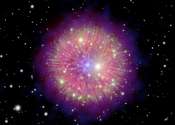
A supernova (pl. supernovae) is a stellar explosion. Supernovae are extremely luminous and cause a burst of radiation that often briefly outshines an entire galaxy, before fading from view over several weeks or months. During this short interval, a supernova can radiate as much energy as the Sun could emit over its life span. The explosion expels much or all of a star's material at a velocity of up to 30,000 km/s (a tenth the speed of light), driving a shock wave into the surrounding interstellar medium. This shock wave sweeps up an expanding shell of gas and dust called a supernova remnant.

Several kinds of supernovae exist that may be triggered in one of two ways, either turning off or suddenly turning on the production of energy through nuclear fusion. After the core of an aging massive star ceases to generate energy from nuclear fusion, it may undergo sudden gravitational collapse into a neutron star or black hole, releasing gravitational potential energy that heats and expels the star's outer layers. Alternatively, a white dwarf star may accumulate sufficient material from a stellar companion (usually through accretion, rarely via a merger) to raise its core temperature enough to ignite carbon fusion, at which point it undergoes runaway nuclear fusion, completely disrupting it. Stellar cores whose furnaces have permanently gone out collapse when their masses exceed the Chandrasekhar limit, while accreting white dwarfs ignite as they approach this limit (roughly 1.38 times the mass of the sun). White dwarfs are also subject to a different, much smaller type of thermonuclear explosion fueled by hydrogen on their surfaces called a nova. Solitary stars with a mass below approximately nine solar masses, such as the Sun itself, evolve into white dwarfs without ever becoming supernovae.

On average, supernovae occur about once every 50 years in a galaxy the size of the Milky Way. They play a significant role in enriching the interstellar medium with higher mass elements. Furthermore, the expanding shock waves from supernova explosions can trigger the formation of new stars.

Nova (plural novae) means "new" in Latin, referring to what appears to be a very bright new star shining in the celestial sphere; the prefix "super-" distinguishes supernovae from ordinary novae, which also involve a star increasing in brightness, though to a lesser extent and through a different mechanism. According to Merriam-Webster's Collegiate Dictionary, the word supernova was first used in print in 1926 and was coined by Swiss astrophysicist and astronomer, Fritz Zwicky.[citation needed]

For more information about Supernova, read the full article at Wikipedia.
This text uses material from Wikipedia and is available under the GNU Free Documentation License.