Iowa State researchers study materials, combustion, cancer with new 'T-ray' instrument
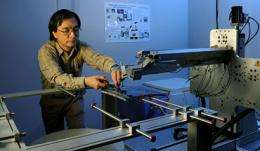
(PhysOrg.com) -- A new, $500,000 instrument recently went about its work emitting and reading high-speed pulses of silent and invisible terahertz rays.
As it did, Thomas Chiou explained how the technology would allow Iowa State University researchers to take a close and unique look at materials reliability, biofuels combustion, environmental clean-up, cancer screening, biomass conversion, ionic liquids and many other research areas in science and engineering.
The Terahertz Ray (or "T-ray") Research Facility at Iowa State's Center for Nondestructive Evaluation (CNDE) gives researchers a state-of-the-art tool to measure and characterize materials, said Chiou, an associate scientist at the center who's managing the new T-ray facility. The instrument should produce useful data for the automotive, aviation, food, energy, materials, pharmaceuticals, medical, forensics, defense and homeland security fields.
"This machine represents a new frequency regime in which measurements can be made," said R. Bruce Thompson, an Anson Marston Distinguished Professor in Engineering, the director of the Center for Nondestructive Evaluation and leader of the collaboration that brought the instrument to Iowa State. "When you have a new way to make measurements, there are new things you can do in applied and fundamental sciences."
Iowa State acquired the instrument with the help of a $342,500 grant from the National Science Foundation's Major Research Instrumentation program. Researchers who worked to acquire the instrument include Thompson; Chiou; Viren Amin, an associate scientist at CNDE and adjunct assistant professor of electrical and computer engineering; Daniel Barnard, an assistant engineer for CNDE and an assistant scientist for the U.S. Department of Energy's Ames Laboratory; Stephen Holland, a group leader at CNDE and an assistant professor of aerospace engineering; David Hsu, a senior scientist for CNDE and adjunct professor of aerospace engineering; John McClelland, a scientist for the Institute for Physical Research and Technology, the Ames Laboratory and an adjunct associate professor of mechanical engineering; Terry Meyer, an assistant professor of mechanical engineering; Say-Kee Ong, a professor of civil, construction and environmental engineering; and Jacob Petrich, professor and chair of chemistry.
Chiou said the new instrument is made possible by advances in ultra-fast laser technology. It emits terahertz rays that are focused on a material or object. The rays reflect back to the receiver and the instrument's controlling computer records and displays the resulting data. That data can show 3-D spatial images of the object's inner structures and also provide spectroscopic analyses of chemical and physical compositions.
The rays - they're between microwave and infrared rays in a relatively unexplored segment of the electromagnetic spectrum - can penetrate many common gases, non-metal solids and some liquids, Chiou said. They're not known to cause harm to people or materials. They also show unique signatures for many materials.
Chiou said the Iowa State T-ray facility will feature two separate systems. One is a time-domain pulsed system suitable for high-speed, time-resolved imaging tasks. The second is a frequency-domain, continuous-wave system for applications requiring finer resolution.
Chiou said the National Aeronautics and Space Administration was the first to demonstrate the technology's potential in nondestructive evaluation when NASA engineers successfully used T-rays to look for defects in the foam that insulates and protects the Space Shuttle's external fuel tanks.
"There are a lot of applications for this technology and we're discovering more and more of them," Chiou said.
And so researchers at Iowa State's Terahertz Ray Research Facility are looking for university and industry collaborators who want to see what the new equipment can do for their projects.
"There is a lot of emphasis on innovation these days," Thompson said. "We see this technology as a way to encourage innovative ideas. We're excited just to try some new things."
Provided by Iowa State University