R&D 100 Award for new NIST/UMD neutron detector
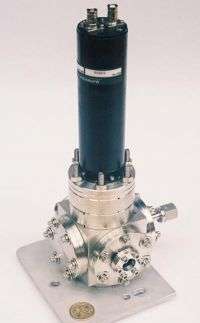
A new ultrasensitive, high bandwidth neutron detector developed by the National Institute of Standards and Technology (NIST) and the University of Maryland (UMD) will receive one of this year's "R&D 100 Awards," it was announced on July 1. The annual R&D 100 Awards program recognizes "the 100 most technologically significant products introduced into the market" during the previous year, as selected by an independent judging panel and the editors of R&D Magazine.
Neutron detectors are important in many applications, ranging from fundamental physics experiments to materials science, reactor operations, oil well logging, monitoring of special nuclear materials, and personal protective equipment for first responders. Conventional neutron detectors are based on proportional counters that detect the high-voltage electrical discharges created when neutrons are absorbed by atoms in a gas cell.
The NIST Lyman alpha neutron detector (LAND), on the other hand, detects neutrons by a more subtle and sensitive technique, measuring "Lyman alpha" radiation in the far ultraviolet region of the spectrum when neutrons are absorbed by a helium isotope. (See "New NIST Detector Can 'See' Single Neutrons Over Broad Range" at www.physorg.com/news124378350.html )
A LAND instrument can detect individual neutrons, which was not possible with proportional counters, and LAND is less susceptible to spurious signals triggered by gamma rays. The device is mechanically robust and requires no specialized fabrication techniques or ultrahigh purity gases. NIST has filed a U.S. patent application on the LAND technology. A paper on LAND principles was published in the NIST Journal of Research in April 2008.
The LAND development team recognized by the R&D 100 Award consists of: Alan K. Thompson and Muhammad Arif of the NIST Ionizing Radiation Division;, Robert E. Vest and Charles W. Clark of the NIST Electron and Optical Physics Division; and Michael A. Coplan of the Institute for Physical Science and Technology, University of Maryland. Critical support for this project was provided by unique NIST calibration facilities for neutron and far ultraviolet radiation, respectively the NIST Center for Neutron Research and the FUV Detector Calibration Facility. Much of the design and construction of the LAND was done at the University of Maryland, College Park.
Citation: A.K. Thompson, M.A. Coplan, J.W. Cooper, P.P. Hughes, R.E. Vest and C. Clark. Observation of the 3He(n,tp) reaction by detection of far-ultraviolet radiation. J. Res. Nat. Inst. Standards Tech. 113, 69 (2008).
Source: NIST


