Researchers Demonstrate 'Quantum Data Buffering' Scheme
February 12, 2009 Researchers Demonstrate 'Quantum Data Buffering' Scheme

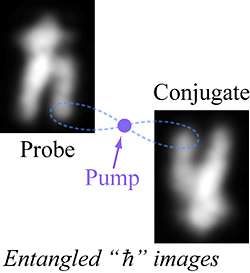
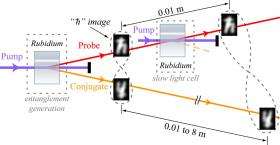
Closeup of two "quantum images" created with the help of a "pump" laser beam. The two images are "entangled," so that if there is a change in the intensity in one region ("pixel") of the image, there would be an identical change in the intensity in the corresponding pixel in the second image. In this experiment, one of the images is delayed on its arrival to a detector, so that the correlations between the two images can be out of sync by up to 27 nanoseconds, something that is potentially useful for managing data to a future "quantum computer." Credit: A. Marino/JQI

(PhysOrg.com) -- Pushing the envelope of Albert Einstein's "spooky action at a distance," known as entanglement, researchers at the Joint Quantum Institute (JQI) of the Commerce Department's National Institute of Standards and Technology and the University of Maryland have demonstrated a "quantum buffer," a technique that could be used to control the data flow inside a quantum computer. Quantum computers could potentially speed up or expand present capabilities in decrypting data, searching large databases, and other tasks. The new research is published in the Feb. 12 issue of the journal Nature.

"If you want to set up some sort of communications system or a quantum information-processing system, you need to control the arrival time of one data stream relative to other data streams coming in," says JQI's Alberto Marino, lead author of the paper. "We can accomplish the delay in a compact setup, and we can rapidly change the delay if we want, something that would not be possible with usual laboratory apparatus such as beamsplitters and mirrors," he says.

This new work follows up on the researchers' landmark creation in 2008 of pairs of multi-pixel quantum images (http://www.physorg.com/news132500362.html). A pair of quantum images is "entangled," which means that their properties are linked in such a way that they exist as a unit rather than individually. In the JQI work, each quantum image is carried by a light beam and consists of up to 100 "pixels." A pixel in one quantum image displays random and unpredictable changes say, in intensity, yet the corresponding pixel in the other image exhibits identical intensity fluctuations at the same time, and these fluctuations are independent from fluctuations in other pixels. This entanglement can persist even if the two images are physically disconnected from one another.

By using a gas cell to slow down one of the light beams to 500 times slower than the speed of light, the group has demonstrated that they could delay the arrival time of one of the entangled images at a detector by up to 27 nanoseconds. The correlations between the two entangled images still occur—but they are out of sync. A flicker in the first image would have a corresponding flicker in the slowed-down image up to 27 nanoseconds later.

While such "delayed entanglement" has been demonstrated before, it has never been accomplished in information-rich quantum images. Up to now, the "spooky action at a distance" has usually been delayed in single-photon systems.

"What gives our system the potential to store lots of data is the combination of having multiple-pixel images and the possibility of each pixel containing 'continuous' values for properties such as the intensity," says co-author Raphael Pooser.

To generate the entanglement, the researchers use a technique known as four-wave mixing, in which incoming light waves are mixed with a "pump" laser beam in a rubidium gas cell to generate a pair of entangled light beams. In their experiment, the researchers then send one of the entangled light beams through a second cell of rubidium gas where a similar four-wave mixing process is used to slow down the beam. The beam is slowed down as a result of the light being absorbed and re-emitted repeatedly in the gas. The amount of delay caused by the gas cell can be controlled by changing the temperature of the cell (by modifying the density of the gas atoms) and also by changing the intensity of the pump beam for the second cell.

This demonstration shows that this type of quantum buffer could be particularly useful for quantum computers, both in its information capacity and its potential to deliver data at precisely defined times.

*More information: A.M. Marino, R.C. Pooser, V. Boyer, and P.D. Lett. Tunable Delay of Einstein-Podolsky-Rosen Entanglement. Nature. Feb. 12, 2009.

Provided by NIST


print this article email this article download pdf blog this article bookmark this article     Stumble it Digg this share on Facebook retweet share on Reddit add to delicious
Rate this story - 4.6 /5 (7 votes)

Rank Filter

Move the slider to adjust rank threshold, so that you can hide some of the comments.


Display comments: newest first

  • ComplexQM - Feb 18, 2009
    • Rank: not rated yet
    Forgive me from asking the obvious but if these quantum images have both been observed AND fixed in position is that not contrary to classical QM?
    Alex
    Complex Quantum Mechanics Yahoo Group
    http://tech.group...echanics

February 12, 2009 all stories

Comments: 1

4.6 /5 (7 votes)
  • Stumble this up

  • Digg this

  • share this

  • hide
  • Related Stories

  • Warming up for Magnetic Resonance Imaging
    created May 08, 2008 | popularity not rated yet | comments 0
  • Physicists Store Images in Vapor
    created Jun 23, 2008 | popularity not rated yet | comments 0
  • Physicists produce quantum-entangled images
    created Jun 12, 2008 | popularity not rated yet | comments 0
  • HYPER-CEST MRI breaks new ground in molecular imaging
    created Oct 19, 2006 | popularity not rated yet | comments 0
  • Quantum gas microscope offers glimpse of quirky ultracold atoms
    created Nov 04, 2009 | popularity not rated yet | comments 0


  • hide
  • Relevant PhysicsForums posts

Other News

Stars Fueled by Dark Matter Could Hold Secrets to the Universe

Stars Fueled by Dark Matter Could Hold Secrets to the Universe

Physics / General Physics

created Nov 03, 2009 | popularity 4.5 / 5 (51) | comments 41

(PhysOrg.com) -- The first stars in the universe may have been very different from the stars we see today, yet they may hold clues to understanding some of the mysterious features of the universe. These "dark ...


Second Law of Thermodynamics May Explain Economic Evolution

Second Law of Thermodynamics May Explain Economic Evolution

Physics / General Physics

created Nov 02, 2009 | popularity 4.3 / 5 (30) | comments 28

(PhysOrg.com) -- Terms such as the "invisible hand," laissez-faire policy, and free-market principles suggest that economic growth and decline in capitalist societies seem to be somehow self-regulated. Now, ...


High-performance plasmas may make reliable, efficient fusion power a reality

High-performance plasmas may make reliable, efficient fusion power a reality

Physics / Plasma Physics

created Nov 02, 2009 | popularity 4.7 / 5 (40) | comments 34

In the quest to produce nuclear fusion energy, researchers from the DIII-D National Fusion Facility have recently confirmed long-standing theoretical predictions that performance, efficiency and reliability ...


'Teapot effect' solved

Solving Teapot Effect

Physics / General Physics

created Nov 02, 2009 | popularity 4.9 / 5 (11) | comments 10

(PhysOrg.com) -- A team of scientists from France have worked out why teapots dribble at low flow rates, and how to stop them. The effect is called the "teapot effect", and solving it could finally put an ...


Laser accelerated protons to the highest energies so far

Researchers use trident laser to accelerate protons to record energies

Physics / General Physics

created Nov 02, 2009 | popularity 4.7 / 5 (6) | comments 10

An international team of physicists at Los Alamos National Laboratory has succeeded in using intense laser light to accelerate protons to energies never before achieved. Using this technique, scientists can ...