A curious pair of galaxies
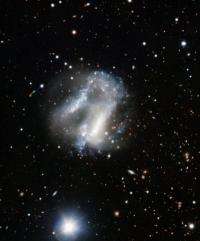
The ESO Very Large Telescope has taken the best image ever of a strange and chaotic duo of interwoven galaxies. The images also contain some surprises -- interlopers both far and near.
Sometimes objects in the sky that appear strange, or different from normal, have a story to tell and prove scientifically very rewarding. This was the idea behind Halton Arp's catalogue of Peculiar Galaxies that appeared in the 1960s. One of the oddballs listed there is Arp 261, which has now been imaged in more detail than ever before using the FORS2 instrument on ESO's Very Large Telescope. The image proves to contain several surprises.
Arp 261 lies about 70 million light-years distant in the constellation of Libra, the Scales. Its chaotic and very unusual structure is created by the interaction of two galaxies that are engaged in a slow motion, but highly disruptive close encounter. Although individual stars are very unlikely to collide in such an event, the huge clouds of gas and dust certainly do crash into each other at high speed, leading to the formation of bright new clusters of very hot stars that are clearly seen in the picture. The paths of the existing stars in the galaxies are also dramatically disrupted, creating the faint swirls extending to the upper left and lower right of the image. Both interacting galaxies were probably dwarfs not unlike the Magellanic Clouds orbiting our own galaxy.
The images used to create this picture were not actually taken to study the interacting galaxies at all, but to investigate the properties of the inconspicuous object just to the right of the brightest part of Arp 261 and close to the centre of the image. This is an unusual exploding star, called SN 1995N, that is thought to be the result of the final collapse of a massive star at the end of its life, a so-called core collapse supernova. SN 1995N is unusual because it has faded very slowly — and still shows clearly on this image more than seven years after the explosion took place! It is also one of the few supernovae to have been observed to emit X-rays. It is thought that these unusual characteristics are a result of the exploding star being in a dense region of space so that the material blasted out from the supernova ploughs into it and creates X-rays.
Apart from the interacting galaxy and its supernova the image also contains several other objects at wildly different distances from us. Starting very close to home, two small asteroids, in our Solar System between the orbits of Mars and Jupiter, happened to cross the images as they were being taken and show up as the red-green-blue trails at the left and top of the picture. The trails arise as the objects are moving during the exposures and also between the exposures through different coloured filters. The asteroid at the top is number 14670 and the one to the left number 9735. They are probably less than 5 km across. The reflected sunlight from these small bodies takes about fifteen minutes to get to the Earth.
The next closest object is probably the apparently bright star at the bottom. It may look bright, but it is still about one hundred times too faint to be seen with the unaided eye. It is most likely a star rather like the Sun and about 500 light-years from us — 20 million times further away than the asteroids. Arp 261 itself, and the supernova, are about 140 000 times further away again than this star, but still in what astronomers would regard as our cosmic neighbourhood. Much more distant still, perhaps some fifty to one hundred times further away than Arp 261, lies the cluster of galaxies visible on the right of the picture. There is no doubt, however, that a much more remote object lies, unrecognised, amongst the faint background objects seen in this marvellous image.


