Slimmer Nanorods Good Fit for Next-Gen 3-D Computer Chips
March 17, 2009 Slimmer Nanorods Good Fit for Next-Gen 3-D Computer Chips

Enlarge

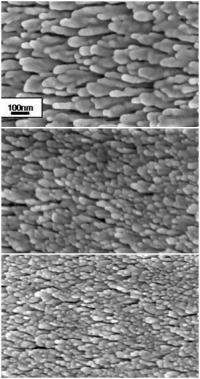
Researchers at Rensselaer Polytechnic Institute have discovered a new method for growing slimmer copper nanorods, which can be used as a low-temperature bonding agent for holding together the layers of next-generation 3-D integrated computer chips. The researchers found that interrupting the nanorod growth process results in thinner rods. Pictured are scanning electron images, at the same magnification, of copper nanorods that have been grown without interruption (top), with two interruptions (middle), and with six interruptions (bottom). Credit: Rensselaer/Pei-I Wang

Researchers at Rensselaer Polytechnic Institute have developed a new technique for growing slimmer copper nanorods, a key step for advancing integrated 3-D chip technology.

These thinner fuse together, or anneal, at about 300 degrees Celsius. This relatively low annealing temperature could make the nanorods ideal for use in heat-sensitive , particularly for "gluing" together the stacked components of 3-D .

"When fabricating and assembling 3-D chips, and when bonding the together, you want as low a temperature as possible," said Pei-I Wang, research associate at Rensselaer's Center for Integrated Electronics. "Slimmer nanorods, by virtue of their smaller diameters, require less heat to anneal. These lower temperatures won't damage or degrade the delicate semiconductors. The end result is a less expensive, more reliable device."

Experimental 3-D computer chips are comprised of several layers of stacked components. Wang said these layers can be coated with thin nanorods, and then heated up to 300 degrees Celsius. Around that temperature, the thin nanorods anneal, turn into a continuous thin film, and fuse the layers together. This study was the first demonstration of slimmer nanorods enabling , according to Wang.

Fundamental research concerning the slimmer nanorods was led by Toh-Ming Lu, the R.P. Baker Distinguished Professor of Physics at Rensselaer. Results of the study were recently published in the journal Nanotechnology.

Research into wafer bonding and incorporating the slimmer nanorods into 3-D integrated computer chips was led by James Jian-Qiang Lu, associate professor in the Department of Electrical, Computer, and Systems Engineering (ECSE) and the Center for Integrated Electronics (CIE) at Rensselaer. Results of the study were recently published in the journal Electrochemical and Solid-State Letters.

The slimmer copper nanorods were formed by periodically interrupting the growth process. The vapor-deposition process was occasionally halted, and the fledgling nanorods were exposed to oxygen. This resulted in a forest of nanorods with diameters between 10 nanometers and 50 nanometers - far smaller than the typical 100-nanometer diameter copper nanorods grown conventionally without interruption.

Vast forests, or arrays, of copper nanorods are produced by vapor deposition at an oblique angle. In a conventional setting, with an uninterrupted stream of copper atoms deposited in a vacuum onto a substrate, the deposition angle naturally results in taller, thicker nanorods.

Periodically interrupting the deposition, and exposing the copper nanorods to ambient air, however, leads to oxygen being absorbed into the surface of the nanorods. During subsequent depositions, this oxidized copper helps to prevent the vaporized copper atoms from migrating away from the very tips of the nanorods. This ensures the nanorods grow taller, without necessarily growing in diameter. The more growth interruptions, the thinner the resulting nanorods, Wang said.

Wang and the research group have filed for a patent for this new technology. The patent is currently pending.

Source: Rensselaer Polytechnic Institute


print this article email this article download pdf blog this article bookmark this article     Stumble it Digg this share on Facebook retweet share on Reddit add to delicious
Rate this story - 4.7 /5 (6 votes)


March 17, 2009 all stories

Comments: 0

4.7 /5 (6 votes)
  • Stumble this up

  • Digg this

  • share this

  • hide
  • Related Stories


  • hide
  • Relevant PhysicsForums posts

  • Can someone help me to better understand energy
    created 1hour ago
  • Calculating Spring Constant - Force or Energy?
    created 1hour ago
  • Helium balloon in a decelerating car
    created 2 hours ago
  • Fractal Nature of Gravitational Forces
    created 15 hours ago
  • More from Physics Forums - General Physics

Other News

New nano color sorters from Molecular Foundry

New nano color sorters from Molecular Foundry

Nanotechnology / Nanophysics

created 1hour ago | popularity 5 / 5 (2) | comments 0

Berkeley Lab researchers have engineered a new class of bowtie-shaped devices that capture, filter and steer light at the nanoscale. These "nano-colorsorter" devices act as antennae to focus and sort light ...


Researchers turn algae into high-temperature hydrogen source

Researchers turn algae into high-temperature hydrogen source

Nanotechnology / Nanophysics

created 3 hours ago | popularity 3.8 / 5 (5) | comments 3

In the quest to make hydrogen as a clean alternative fuel source, researchers have been stymied about how to create usable hydrogen that is clean and sustainable without relying on an intensive, high-energy ...


findNano app puts nanotech in your pocket

Nanotechnology / Bio & Medicine

created 1hour ago | popularity not rated yet | comments 0

The Project on Emerging Nanotechnologies (PEN) has developed findNano, an application for Apple's iPhone and iPod Touch that lets users discover and determine whether consumer products are nanotechnology-enabled. Nanotechnology, ...


In touch with molecules

In touch with molecules

Nanotechnology / Nanophysics

created 1hour ago | popularity not rated yet | comments 0

The performance of modern electronics increases steadily on a fast pace thanks to the ongoing miniaturization of the utilized components. However, se-vere problems arise due to quantum-mechanical phenomena ...


Understanding mechanical properties of silicon nanowires paves way for nanodevices

Understanding mechanical properties of silicon nanowires paves way for nanodevices

Nanotechnology / Nanomaterials

created 23 hours ago | popularity 4.5 / 5 (2) | comments 0

Silicon nanowires are attracting significant attention from the electronics industry due to the drive for ever-smaller electronic devices, from cell phones to computers. The operation of these future devices, ...