Researchers Identify New Protein Important in Breast Cancer Gene's Role in DNA Repair
(PhysOrg.com) -- For years, researchers have known that under normal conditions, the breast cancer protein BRCA1 orchestrates the repair of damaged DNA, but the details of just how BRCA1 moves to the damaged site and recruits the right nuclear repairmen for DNA restoration remains a mystery.
Now, a new study from the University of Pennsylvania School of Medicine has identified genes associated with the BRCA1 protein and their involvement in the DNA repair pathway, helping to clear the way for researchers to better understand what goes wrong when the BRCA1 gene is mutated and the repair pathway goes haywire. Identifying patients with mutations in these BRCA1-associated genes may help better fight breast cancer.
The new study appears in the most recent issue of Genes & Development.
“A mutated BRCA1 gene increases vulnerability to breast and ovarian cancers by increasing the rate at which genes are altered,” says Roger Greenberg, MD, PhD, Assistant Professor of Cancer Biology at the Abramson Family Cancer Research Institute at the University of Pennsylvania. Previous studies have shown that mutated BRCA1-associated proteins also increase the risk of breast cancer, implying that a BRCA1-centered DNA repair pathway is necessary to suppress cancer.
About two years ago, Greenberg helped to lead a study that identified the role of a BRCA1-associated protein called RAP80. The BRCA1 protein works in partnership with RAP80 to locate damaged DNA sites. Cancer-causing mutant BRCA1 proteins fail to pair up with RAP80, which, in turn, blinds BRCA1 to DNA damage. The results of the study led Greenberg’s group to look closer at the interaction between BRCA1 and RAP80 to learn the molecular details of how this complex functioned in DNA repair and to explore RAP80 as a possible breast-cancer-susceptibility gene candidate.
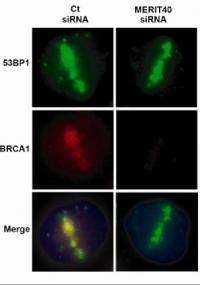
In the latest study, Greenberg’s team returned to the BRCA1-RAP80 complex for additional analysis, and identified another protein called MERIT40 that works with BRCA1-RAP80 to achieve DNA repair. MERIT40, a previously unknown protein, was revealed by purifying BRCA1-RAP80 complexes from human cells. MERIT40 not only recruits BRCA1 and RAP80 to the sites of DNA damage and signals for DNA repairman to the site, but also acts as the molecular scaffold for the BRCA1-RAP80 complex.
“The BRCA1-RAP80 protein complex works as machine. If a piece of the machine is missing, the machine will begin to break down and eventually stop working,” says Greenberg. Without MERIT40, Greenberg’s group discovered that the BRCA1-RAP80 complex degrades, denying BRCA1 access to the DNA damage sites within the genome.
The identification of MERIT40 as a BRCA1-associated gene may also lead researchers to other genes that increase vulnerability to breast cancer. Greenberg said the identification of the fundamental role of RAP80 several years ago has led researchers to explore RAP80 as a cancer-causing gene. Greenberg said ongoing studies have confirmed that mutations to the RAP80 gene occur in human populations and may cause cancer. These reports will be published later this year, he said.
“There are many genes associated with BRCA1 that turn out to be mutated in breast cancer,” Greenberg said. “MERIT40 now becomes another good gene to study.”
Understanding how BRCA responds to damaged DNA can also help scientists to better fight cancer with chemotherapy, notes Greenberg. By shutting MERIT40 genes off, researchers may be able to weaken cancer cells, leaving them more susceptible to attack by chemotherapy.
In the future, Greenberg says he hopes to gain a better understanding of how MERIT40 works by looking for MERIT40 mutations in breast cancer patients.
The National Cancer Institute, the Sidney Kimmel Foundation Scholar Award, The Mary Kay Ash Foundation Translational Innovation Award and the Abramson Family Cancer Research Institute funded this research.
Provided by University of Pennsylvania


