A New Way of Treating the Flu
July 6, 2009 A New Way of Treating the Flu

Enlarge

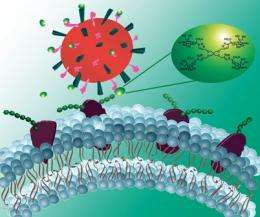
Linhardt’s new compound (green spheres) blocks both the N (pink spikes) and H (blue spikes) portion of the flu virus. The compound prevents the infection of the cell and the spread of the flu to other cells like. Image Credit: Rensselaer/Melissa Kemp

(PhysOrg.com) -- What happens if the next big influenza mutation proves resistant to the available anti-viral drugs? This question was presenting itself to scientists and health officials recently at the World Health Assembly in Geneva, Switzerland, as they continued to do battle with H1N1, the so-called swine flu, and prepared for the next iteration of the ever-changing flu virus.

Promising new research announced by Rensselaer Polytechnic Institute could provide an entirely new tool to combat the . The discovery is a one-two punch that targets the illness on two fronts, going one critical step further than any currently available flu drug.

“We have been fortunate with H1N1 because it has been responding well to available drugs. But if the virus mutates substantially, the currently available drugs might be ineffective because they only target one portion of the virus,” said Robert Linhardt, the Ann and John H. Broadbent Jr. ’59 Senior Constellation Professor of and Metabolic Engineering. “By targeting both portions of the virus, the H and the N, we can interfere with both the initial attachment to the cell that is being infected and the release of the budding virus from the cell that has been affected.”

The findings of the team, which have broad implications for future flu drugs, are featured on the cover of the June edition of European Journal of Organic Chemistry.

The is classified based on the form of two of its outer proteins, hemagglutinin (H) and neuraminidase (N). Each classification — for example H5NI “” or H1N1 “” — represents a different mutation of hemagglutinin and neuraminidase or H and N.

Flu drugs currently on the market target only the neuraminidase proteins, and disrupt the ability of the virus to escape an infected cell and move elsewhere to infect other healthy . The new process developed by Linhardt is already showing strong binding potential to hemagglutinin, which binds to sialic acid on the surface of a healthy cell, allowing the virus to enter the cell.

“We are seeing promising preliminary results that the chemistry of this approach will be effective in blocking the hemagglutinin portion of the disease that is currently not targeted by any drug on the market,” he said.

In addition, Linhardt and his team have shown their compound to be just as effective at targeting neuraminidase as the most popular drugs on the market, according to Linhardt.

The approach can also be modified to specifically target the neuraminidase or the hemagglutinin, or both, depending on the type of mutation that is present in the current version of the flu, according to Linhardt.

In the next steps of his research, Linhardt will look at how their compounds bind to hemagglutinin, and he will test the ability to block the virus first in cell cultures and then in infected animal models.

“It is still early in the process,” he said. “We are several steps away from a new drug, but this technique is allowing us to move very quickly in creating and testing these compounds.”

The technique that Linhardt used is the increasingly popular technique of “click chemistry.” Linhardt is among the first researchers in the world to utilize the technique to create new anti-viral agents. The process allows chemists to join small units of a substance together quickly to create a new, full substance.

In this case, Linhardt used the technique to quickly build a new derivative of sialic acid. Because it is chemically very similar to the sialic acid found on the surface of a cell, the could mistake the compound as the real sialic acid and bind to it instead of the cell, eliminating the connections to hemagglutinin and neuraminidase that are required for initial infection and spread of the infection in the body. The currently available drugs are translation-state inhibitors whose chemical structure allows them to only effectively target the neuraminidase.

Provided by Rensselaer Polytechnic Institute (news : web)


print this article email this article download pdf blog this article bookmark this article     Stumble it Digg this share on Facebook retweet share on Reddit add to delicious
Rate this story - 4.3 /5 (6 votes)

Rank Filter

Move the slider to adjust rank threshold, so that you can hide some of the comments.


Display comments: newest first

  • ZeroDelta - Jul 06, 2009
    • Rank: not rated yet
    This was disclosed in May. Take it from a local!
    RPI - 2 H1N1 - 0
  • E_L_Earnhardt - Jul 07, 2009
    • Rank: 1 / 5 (1)
    I had rather you kill it in the pig, bird, wherever! Dose anyone know the ongoing source?
  • denijane - Jul 10, 2009
    • Rank: not rated yet
    I don't get it, why do we need to treat the flu if it's non-lethal? And what's even worst, why do we have to make it sound like it's important to have those antiviral drugs for influenza viruses that are no more dangerous than regular flu.

July 6, 2009 all stories

Comments: 3

4.3 /5 (6 votes)
  • Stumble this up

  • Digg this

  • share this

  • hide
  • Related Stories

  • A New Way of Treating the Flu
    created Jun 13, 2009 | popularity not rated yet | comments 0
  • A new way of the treating the flu: Approach targets both the H and N portions of the virus
    created May 19, 2009 | popularity not rated yet | comments 0
  • Changes in amino acids in the 1918 influenza virus cut transmission
    created Feb 05, 2007 | popularity not rated yet | comments 0
  • Structure of influenza B virus protein gives clues to next pandemic
    created Oct 15, 2007 | popularity not rated yet | comments 0
  • Flu shot might also offer some protection against H5N1
    created Feb 13, 2007 | popularity not rated yet | comments 0


  • hide
  • Relevant PhysicsForums posts

  • Concentrating Household Ammonia
    created 4 hours ago
  • Structure of Dinitroacetylene
    created 5 hours ago
  • How do they melt carbon?
    created Nov 06, 2009
  • Urgent help needed for question on electrolysis & comparing Eo values
    created Nov 05, 2009
  • Ionic vs. Covalent
    created Nov 05, 2009
  • Gas that turn into liquid have a boiling point?
    created Nov 04, 2009
  • More from Physics Forums - Chemistry

Other News

Toward home-brewed electricity with 'personalized solar energy'

Toward home-brewed electricity with 'personalized solar energy'

Chemistry / Materials Science

created Nov 04, 2009 | popularity 3.4 / 5 (9) | comments 4

New scientific discoveries are moving society toward the era of "personalized solar energy," in which the focus of electricity production shifts from huge central generating stations to individuals in their ...


Scientists Reproduce a Building Block of Life in Laboratory

Scientists Reproduce a Building Block of Life in Laboratory

Chemistry / Biochemistry

created Nov 06, 2009 | popularity 4.8 / 5 (21) | comments 0

(PhysOrg.com) -- NASA scientists studying the origin of life have reproduced uracil, a key component of our hereditary material, in the laboratory.


Newly Discovered Fat Molecule: An Undersea Killer with an Upside

Newly Discovered Fat Molecule: An Undersea Killer with an Upside

Chemistry / Biochemistry

created Nov 05, 2009 | popularity 4.9 / 5 (8) | comments 0

(PhysOrg.com) -- A chemical culprit responsible for the rapid, mysterious death of phytoplankton in the North Atlantic Ocean has been found by collaborating scientists at Rutgers University and the Woods Hole ...


CU-Boulder map of human bacterial diversity shows wide interpersonal differences

Map of Human Bacterial Diversity Shows Wide Interpersonal Differences

Chemistry / Biochemistry

created Nov 05, 2009 | popularity 4.7 / 5 (11) | comments 0

(PhysOrg.com) -- A University of Colorado at Boulder team has developed the first atlas of bacterial diversity across the human body, charting wide variations in microbe populations that live in different ...


Mimicking nature, scientists can now extend redox potentials

Mimicking nature, scientists can now extend redox potentials

Chemistry / Biochemistry

created Nov 04, 2009 | popularity 4.8 / 5 (5) | comments 0

(PhysOrg.com) -- New insight into how nature handles some fundamental processes is guiding researchers in the design of tailor-made proteins for applications such as artificial photosynthetic centers, long-range ...