Seafloor Fossils Provide Clues on Climate Change
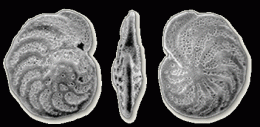
Deep under the sea, a fossil the size of a sand grain is nestled among a billion of its closest dead relatives. Known as foraminifera, these complex little shells of calcium carbonate can tell you the sea level, temperature, and ocean conditions of Earth millions of years ago. That is, if you know what to look for.
Assistant Professor of Earth and Environmental Sciences at Rensselaer Polytechnic Institute Miriam Katz has spent the past two decades studying these ancient, deep-sea fossils to reconstruct the climates of Earth up to 250 million years ago. Through ice ages and greenhouse climates, Katz has been able to piece together oxygen, carbon, and faunal data to paint a portrait of how, when, and why our climate has changed so drastically over geologic history. In addition, her investigations into the deep past of Earth have important implications for understanding and tracking the potential drastic repercussions of modern, human-induced climate change.
“There is a saying among scientists in my field that ‘the past is a window on the future,’ ” Katz said. “By reconstructing the climates of the past, particularly those where we see massive and rapid changes in the climate, we can provide a science-based means to explore or predict possible system responses to the current climate change.”
While her work requires a lot of time in the laboratory, Katz has spent nearly two years at sea on seven different ocean voyages around the world to drill for foraminifera as part of the Integrated Ocean Drilling Program (IODP), an international marine research effort that explores the Earth’s history and structure by looking at seafloor sediments and rocks. During each two-month IODP excursion, Katz and the other scientists on board never set foot on land and spend hours poking through the millions of layers of sediment, trapped gases, fossils, and trace elements found in huge cores drilled from deep under the seafloor.
Just a few inches in diameter, each core is painstakingly drilled and removed from the seafloor. From top to bottom, the core provides a reverse chronology of the various organisms, sediments, and elements that were found on Earth throughout history. Unlike cores from sedimentary layers from the continents that are quickly destroyed by the forces of plate tectonics, wind, and water, these rarely disturbed ocean sediment cores can provide records up to 180 million years ago as new layers of sediment bury and preserve those of the past.
Katz is most interested in the foraminifera found in the cores. The foraminifera she studies live on or just below the seafloor. When they die, their hard shells are incorporated in the surrounding sediments and buried over time in a nearly uniform layer.
The assemblages of foraminifera in each layer can provide valuable information on the climate of that time. “Some species are only found in certain environments, such as in warm water or in shallow, tidal areas,” Katz said. “By piecing together the species assemblages that are found in a given area during the given time period, we can reconstruct the sea level and ocean and climate conditions of that period based on our knowledge of each foraminiferal species.”
In addition to the specific type of foraminifera seen in each layer, valuable information can also be gathered by looking at variations in the chemical structure of the fossilized calcium carbonate (CaCO3) shell seen in the various layers. During their life, the foraminiferal shells are formed from the elements found in the seas that they lived in. The ratios of various isotopes of the elements carbon and oxygen found in foraminiferal shells at different times in Earth’s history provide important information needed to reconstruct the climate and ocean waters that surrounded them during their short lives millions of years ago.
In the case of oxygen (O), the ratio between isotopes 18O and 16O tells scientists how much water is trapped in glacial ice, providing important clues about temperature and the size of the ancient continental ice sheets. Carbon (C) in the shells can be analyzed for either 12C or 13C isotopes. Plants prefer to incorporate lighter 12C during photosynthesis, increasing the ratio of 13C to 12C in foraminifera when plant and algae production is high. This carbon data provides clues on the types and amounts of vegetation at various times as well as ocean circulation, according to Katz.
Gathering this information from cores has allowed Katz to develop important theories on one of the most recent and dramatic climate change events that has occurred in recent geologic history - the transition from the greenhouse climate of the Eocene epoch to the “icehouse” or glacial conditions of the Oligocene epoch approximately 33.5 million years ago.
“The boundary between the late Eocene to the early Oligocene is a striking example of rapid climate change that we can look to in Earth’s past,” Katz said. “Information from this period can provide us with important information on how rapid changes in temperature can significantly impact ice volume, sea level, and the evolution of life on Earth.”
Katz has used oxygen and carbon isotopes as well as the ratio of magnesium to calcium within foraminifera from this period to reconstruct the changes that occurred as the climate rapidly cooled. Along with her research colleagues, she has shown that ice sheets at the end of the transition were approximately 25 percent larger than today, causing a decrease in sea level of approximately 105 meters.
Her research also reaches even further back to reconstruct conditions earlier in Earth’s history. In particular, she took part in a study of atmospheric oxygen and carbon dioxide concentrations since the Jurassic period 205 million years ago. The group has found that oxygen levels doubled in the short period of time from the Jurassic period to the Eocene epoch (~150 million years ago), providing a climate with just enough oxygen for placental mammals to develop.
More information: More information on her research can be found at: www.rpi.edu/~katzm/ . More information on the Integrated Ocean Drilling Program can be found at www.iodp-usio.org/ .
Provided by Rensselaer Polytechnic Institute (news : web)


