A Tale of Planetary Woe (w/ Video)
November 11, 2009 by Patrick Barry A Tale of Planetary Woe

Enlarge

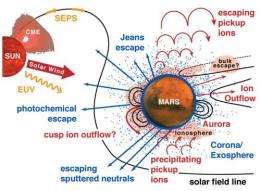
The loss of martian atmosphere could be caused by a complex set of mechanisms working simultaneously. MAVEN is equipped with eight different sensors designed to sort out the confusion.

Once upon a time — roughly four billion years ago — Mars was warm and wet, much like Earth. Liquid water flowed on the Martian surface in long rivers that emptied into shallow seas. A thick atmosphere blanketed the planet and kept it warm. Living microbes might have even arisen, some scientists believe, starting Mars down the path toward becoming a second life-filled planet next door to our own.

But that's not how things turned out.

Mars today is bitter cold and bone dry. The rivers and seas are long gone. Its atmosphere is thin and wispy, and if Martian microbes still exist, they're probably eking out a meager existence somewhere beneath the dusty .

What happened? Why did Mars dry up and freeze over? These haunting questions have long puzzled scientists. A few years from now we might finally know the answer, thanks to a new orbiter NASA will send to Mars called MAVEN (short for Mars Atmosphere and Volatile Evolution).

FLV player

An artist's concept of solar wind blowing away the atmosphere of Mars. This is just one of several plausible explanations for what happened to the Red Planet.

"The goal of MAVEN is to figure out what processes were responsible for those changes in the climate," says Bruce Jakosky, Principal Investigator for MAVEN at the University of Colorado at Boulder.

One way or another, scientists believe, Mars must have lost its most precious asset: its thick atmosphere of carbon dioxide. CO2 in Mars's atmosphere is a , just as it is in our own atmosphere. A thick blanket of CO2 and other greenhouse gases would have provided the warmer temperatures and greater atmospheric pressure required to keep from freezing solid or boiling away.

Over the last four billion years, Mars somehow lost most of that blanket. Scientists have proposed various theories for how that loss happened. Perhaps an blew most of the atmosphere into space in one catastrophic event. Or maybe erosion by the — a stream of charged particles emanating from the sun — could have slowly stripped the atmosphere away over eons. The planet's surface might also have absorbed the CO2 and locked it up in minerals such as carbonate.

Ultimately, nobody knows for sure where all the missing CO2 went.

MAVEN will be the first mission to Mars specifically designed to help scientists understand the ongoing escape of CO2 and other gases into space. The probe will orbit Mars for at least one Earth-year. At the elliptical orbit's low point, MAVEN will be 125 km above the surface; its high point will take it more than 6000 km out into space. This wide range of altitudes will enable MAVEN to sample Mars's atmosphere more thoroughly than ever before.

As it orbits, MAVEN's instruments will track ions and molecules in this broad cross-section of the Martian atmosphere, thoroughly documenting the flow of CO2 and other molecules into space for the first time.

Once Jakosky and his colleagues know how quickly Mars is losing CO2 right now, they can extrapolate backward in time to estimate the total amount lost to space during the last four billion years. "MAVEN will determine if [loss to space] was the most important player," Jakosky says.

But just as important as "how much?" is the question of "how?"

Conventional wisdom holds that Mars's atmosphere is vulnerable because the planet lacks a global magnetic field. Earth's magnetic field stretches far out into space and envelopes the whole planet in a protective bubble that deflects the solar wind. Mars has only regional, patchy magnetic fields that cover relatively small areas of the planet, mostly in the southern hemisphere. The rest of the atmosphere is fully exposed to the solar wind. So the loss could be caused by the slow erosion of the atmosphere in these exposed areas.
A Tale of Planetary Woe
Enlarge

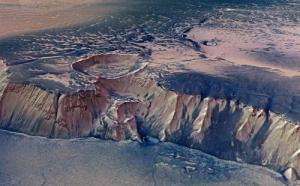
Planetary scientists believe that waterfalls may have once cascaded down these steep cliffs at Echus Chasma on Mars. Mars has many desiccated landscapes like this one, thought to have been sculpted by abundant water in the distant past. Photo credit: Mars Express/ESA.

David Brain of UC Berkeley has proposed another, seemingly contrary possibility. These small magnetic fields might actually hasten the loss of Mars's atmosphere, Brain suggests.

The solar wind might buffet those magnetic field lines, occasionally pinching off a "bubble" of field lines that then drifts off into space — carrying a large chunk of the with it. If so, having a partial magnetic field might be worse than having none at all. This possibility was described in "Solar Wind Rips Up Martian Atmosphere."

Some evidence from NASA's Mars Global Surveyor spacecraft supports Brain's theory, but decisive measurements will have to wait for MAVEN, currently scheduled to launch in 2013.

The mission will be a big step toward understanding what happened to — how it ended up so cold and dry after such a warm and watery beginning. After all these years, MAVEN could write the final chapter in a haunting tale of planetary woe.

Source: Science@NASA, by Patrick Barry


print this article email this article download pdf blog this article bookmark this article     Stumble it Digg this share on Facebook retweet share on Reddit add to delicious
Rate this story - 4.2 /5 (11 votes)

Rank Filter

Move the slider to adjust rank threshold, so that you can hide some of the comments.


Display comments: newest first

  • magpies - Nov 11, 2009
    • Rank: 2.3 / 5 (3)
    It probably lost its magnetic field the same way the earth will lose its magnetic field. Martians developed advanced eletrical technologys without considering what would happen if they put thouse type of magnetic fields around their own magnetic planet. Think about it :)
  • probes - Nov 12, 2009
    • Rank: 1 / 5 (2)
    We must develop a 1KW VASIMR engine. Then we could get to Mars in 3.9 days.
  • out7x - Nov 12, 2009
    • Rank: not rated yet
    The martians only weighed one-third earth weight. Thats why the solar wind fried them.
  • Birger - Nov 12, 2009
    • Rank: not rated yet
    See the article in Nature (290 october 2009, p1227) "Volatile accretion history of the terrestrial planmets and a dynamic implications". The terrestrial planets apparently received most of their water from beyond the asteroid belt, in a process that peaked ca. 100 million years after the creation of the Solar system. This mechanism seems to have disfavoured Mars.
  • Shootist - Nov 12, 2009
    • Rank: not rated yet
    Just want to mention that the Hellas impact basin is large enough (2300km), and old enough (LHB - 3.9GYa), to explain the lack of Martian atmosphere.

    Hellas Planitia is also antipodal to Alba Patera, suggesting some connection, between the Solar System's second largest crater, and its largest volcano.

November 11, 2009 all stories

Comments: 5

4.2 /5 (11 votes)
  • Stumble this up

  • Digg this

  • share this

  • hide
  • Related Stories

  • Solar Wind Rips Up Martian Atmosphere
    created Nov 21, 2008 | popularity not rated yet | comments 0
  • NASA selects CU-Boulder to lead $485M Mars mission
    created Sep 15, 2008 | popularity not rated yet | comments 0
  • Mars Express latest findings give hints about water loss in the Martian atmosphere
    created Sep 27, 2004 | popularity not rated yet | comments 0
  • Magnetic Tornadoes Could Liberate Mercury's Tenuous Atmosphere
    created Jun 02, 2009 | popularity not rated yet | comments 0
  • Mars and Venus are surprisingly similar
    created Mar 05, 2008 | popularity not rated yet | comments 0


  • hide
  • Relevant PhysicsForums posts

  • basic 'our universe' question..
    created 2 hours ago
  • deriving keplers law
    created Nov 19, 2009
  • rotation of Earth
    created Nov 18, 2009
  • elliptical orbits
    created Nov 18, 2009
  • Apophis
    created Nov 18, 2009
  • Summer Research project
    created Nov 18, 2009
  • More from Physics Forums - General Astronomy

Other News

Cassini's Big Sky: The View from the Center of Our Solar System

Cassini's Big Sky: The View from the Center of Our Solar System

Space & Earth / Space Exploration

created 11 hours ago | popularity 4.7 / 5 (10) | comments 1

(PhysOrg.com) -- When NASA's Cassini spacecraft began orbiting Saturn five years ago, a dozen highly-tuned science instruments set to work surveying, sniffing, analyzing and scrutinizing the Saturnian system.


More than 18 million cubic metres of sand are set to be poured onto the new coastal band of dunes until 2011

Dutch build more dunes against rising seas

Space & Earth / Environment

created 6 hours ago | popularity 5 / 5 (1) | comments 0

On the beach at Monster, bulldozers painstakingly turn sand dredged from the bottom of the North Sea bed into dunes in an ambitious effort to safeguard the Netherlands from flooding.


NJIT receives funding to improve Big Bear Telescope, study solar energy

NJIT receives funding to improve Big Bear Telescope, study solar energy

Space & Earth / Astronomy

created 3 hours ago | popularity 4 / 5 (2) | comments 0

NJIT researchers are at work on many scientific and technological frontiers. The National Science Foundation has recently provided support that totals nearly $4.3 million for the diverse efforts of the following ...


New Method to Measure Snow, Soil Moisture With GPS May Benefit Meteorologists, Farmers

Space & Earth / Earth Sciences

created 6 hours ago | popularity not rated yet | comments 1

(PhysOrg.com) -- A research team led by the University of Colorado at Boulder has found a clever way to use traditional GPS satellite signals to measure snow depth as well as soil and vegetation moisture, a technique expected ...


Astronauts await word of baby girl on Earth (AP)

Astronauts await word of baby girl on Earth

Space & Earth / Space Exploration

created 7 hours ago | popularity 5 / 5 (1) | comments 0

(AP) -- Atlantis' astronauts anxiously awaited word on the birth of one crewman's daughter Friday, as they moved more supplies into the International Space Station and geared up for another spacewalk.