Scientists demonstrate 'universal' programmable quantum processor
November 15, 2009 Scientists demonstrate 'universal' programmable quantum processor

Enlarge

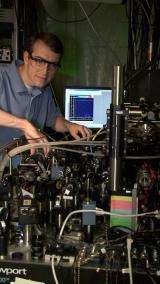
NIST postdoctoral researcher David Hanneke at the laser table used to demonstrate the first universal programmable processor for a potential quantum computer. A pair of beryllium ions (charged atoms) that hold information in the processor are trapped inside the cylinder at the lower right. A colorized image of the two ions is displayed on the monitor in the background. Credit: J. Burrus/NIST

Physicists at the National Institute of Standards and Technology have demonstrated the first "universal" programmable quantum information
processor able to run any program allowed by quantum mechanics -- the rules governing the submicroscopic world -- using two quantum bits (qubits) of information. The processor could be a module in a future quantum computer, which theoretically could solve some important problems that are intractable today.

The NIST demonstration, described in Nature Physics, marks the first time any research group has moved beyond demonstrating individual tasks for a quantum processor—as done previously at NIST and elsewhere—to perform programmable processing, combining enough inputs and continuous steps to run any possible two-qubit program.

The NIST team also analyzed the quantum processor with the methods used in traditional computer science and electronics by creating a diagram of the processing circuit and mathematically determining the 15 different starting values and sequences of processing operations needed to run a given program. "This is the first time anyone has demonstrated a programmable quantum processor for more than one ," says NIST postdoctoral researcher David Hanneke, first author of the paper. "It's a step toward the big goal of doing calculations with lots and lots of qubits. The idea is you'd have lots of these processors, and you'd link them together."

The NIST processor stores binary information (1s and 0s) in two beryllium ions (electrically charged atoms), which are held in an electromagnetic trap and manipulated with ultraviolet lasers. Two ions in the trap help cool the beryllium ions.

NIST scientists can manipulate the states of each qubit, including placing the ions in a "superposition" of both 1 and 0 values at the same time, a significant potential advantage of information processing in the quantum world. Scientists also can "entangle" the two qubits, a quantum phenomenon that links the pair's properties even when the ions are physically separated.

With these capabilities, the NIST team performed 160 different processing routines on the two qubits. Although there are an infinite number of possible two-qubit programs, this set of 160 is large and diverse enough to fairly represent them, Hanneke says, making the processor "universal." Key to the experimental design was use of a random number generator to select the particular routines that would be executed, so all possible programs had an equal chance of selection. This approach was chosen to avoid bias in testing the processor, in the event that some programs ran better or produced more accurate outputs than others.

Ions are among several promising types of qubits for a quantum computer. If they can be built, quantum computers have many possible applications such as breaking today's most widely used encryption codes, such as those that protect electronic financial transactions. In addition to its possible use as a module of a quantum computer, the new processor might be used as a miniature simulator for interactions in any quantum system that employs two energy levels, such as the two-level ion qubit systems that represent energy levels as 0s and 1s. Large quantum simulators could, for example, help explain the mystery of high-temperature superconductivity, the transmission of electricity with zero resistance at temperatures that may be practical for efficient storage and distribution of electric power.

The new paper is the same NIST research group's third major paper published this year based on data from experiments with trapped ions. They previously demonstrated sustained quantum information processing and entanglement in a mechanical system similar to those in the macroscopic everyday world. NIST research contributes to advances in national priority areas, such as information security, as well as NIST mission work in precision measurement and atomic clocks.

In the latest NIST experiments reported in Nature Physics, each program consisted of 31 logic operations, 15 of which were varied in the programming process. A logic operation is a rule specifying a particular manipulation of one or two qubits. In traditional computers, these operations are written into software code and performed by hardware.

The programs did not perform easily described mathematical calculations. Rather, they involved various single-qubit "rotations" and two-qubit entanglements. As an example of a rotation, if a qubit is envisioned as a dot on a sphere at the north pole for 0, at the south pole for 1, or on the equator for a balanced superposition of 0 and 1, the dot might be rotated to a different point on the sphere, perhaps from the northern to the southern hemisphere, making it more of a 1 than a 0.

Each program operated accurately an average of 79 percent of the time across 900 runs, each run lasting about 37 milliseconds. To evaluate the processor and the quality of its operation, NIST scientists compared the measured outputs of the programs to idealized, theoretical results. They also performed extra measurements on 11 of the 160 programs, to more fully reconstruct how they ran and double-check the outputs.

As noted in the paper, many more qubits and logic operations will be required to solve large problems. A significant challenge for future research will be reducing the errors that build up during successive operations. Program accuracy rates will need to be boosted substantially, both to achieve fault-tolerant computing and to reduce the computational "overhead" needed to correct errors after they occur, according to the paper.

As a non-regulatory agency of the U.S. Department of Commerce, NIST promotes U.S. innovation and industrial competitiveness by advancing measurement science, standards and technology in ways that enhance economic security and improve our quality of life.

More information: D. Hanneke, J.P. Home, J.D. Jost, J.M. Amini, D. Leibfried & D.J. Wineland. 2009. Realization of a programmable two-qubit quantum processor. . Posted online Nov. 15.

Source: National Institute of Standards and Technology (news : web)


print this article email this article download pdf blog this article bookmark this article     Stumble it Digg this share on Facebook retweet share on Reddit add to delicious
Rate this story - 4.6 /5 (21 votes)

Rank Filter

Move the slider to adjust rank threshold, so that you can hide some of the comments.


Display comments: newest first

  • NeilFarbstein - Nov 15, 2009
    • Rank: not rated yet
    "The programs did not perform easily described mathematical calculations. Rather, they involved various single-qubit "rotations" and two-qubit entanglements. As an example of a rotation, if a qubit is envisioned as a dot on a sphere at the north pole for 0, at the south pole for 1, or on the equator for a balanced superposition of 0 and 1, the dot might be rotated to a different point on the sphere, perhaps from the northern to the southern hemisphere, making it more of a 1 than a 0. "
    Whats the difference between a q bit processor and an analog computer? The placement of dots on the "globes" seems to be an analog function. Smoothly varying and continuous. Do the dots stop at points of quantum nodes?
  • Damon_Hastings - Nov 15, 2009
    • Rank: not rated yet
    I think it has something to do with the superposition of states allowing massively parallel computation within a single processor. In essence, the processor tries out all possible solutions to a problem simultaneously, with each potential solution represented by one state in the superposition. The correct solution is then "chosen" by the instantaneous waveform collapse (where the collapse is guided by the probability distribution function carefully crafted by the processor). Thus, the processor tries out thousands of solutions in the time it would normally take to try only one. And now put tons of those processors on the same chip!

    But I don't pretend to really understand any of this. As a computer programmer, I'm beginning to wonder whether I'm going to need QM classes to program future computers effectively...
  • Arikin - Nov 15, 2009
    • Rank: not rated yet
    Damon_Hastings, You won't need QM classes. That is the whole point of the "programs" they were testing. Abstraction from the inner hardware workings allows you the programmer to program and not think about that.

    This is almost the same process of current computers when the modern version started out. Think of room sized computers with punch cards that could barely do anything.
  • Damon_Hastings - Nov 15, 2009
    • Rank: not rated yet
    Well, the programs they were testing in this article consisted entirely of esoteric quantum operations such as "rotations" and "entanglements". Same story with all existing "quantum programming languages" listed at http://en.wikiped...gramming

    There are efforts underway to create a functional (conventional) Quantum Programming language, but they're still very much in the early stages: http://www.dcs.gl...rvey.pdf -- and they'll be... weird.

    "quantum computers raise interesting problems
    for the design of programming languages"

    "it was only in 1996 that work towards the design of [high-level Quantum Programming] languages began to be published."

    I'm certain today's programs will run on tomorrow's quantum computers, but they might not actually make use of those computers' "quantumness", i.e. the massive internal parallelism that will provide such incredible speed -- unless you translate the programs to a QP language.
  • ReeseJ2 - Nov 16, 2009
    • Rank: not rated yet
    I would tend to agree, the language used to make use of the new properties of quantum computers will certainly be very different from anything used now, but think about the difference between, say, Scheme and C. Just like you don't need to understand the differences in the machine code underlying Scheme and C, I suspect that no good QP language would require any sort of understanding of quantum mechanics. A different kind of logical thought, certainly, but not quantum mechanics.
  • Damon_Hastings - Nov 16, 2009
    • Rank: 5 / 5 (2)
    Man, I hope you're right. After a few hours of studying QM, I inevitably start to feel like someone must have slipped a tab of acid into my drink...
  • Noumenon - Nov 16, 2009
    • Rank: not rated yet
    ".... have many possible applications such as breaking today's most widely used encryption codes, such as those that protect electronic financial transactions"

    Why would anyone want to do this?
  • Noumenon - Nov 16, 2009
    • Rank: not rated yet
    I agree Damen. I worked as a programmer also and have mastered the art of 'spaghetti code' in c and assembler, but I'm afraid quantum programming will make my 'worst' efforts seem like cobol.
  • eachus - Nov 16, 2009
    • Rank: not rated yet
    Damon_Hastings:
    Man, I hope you're right. After a few hours of studying QM, I inevitably start to feel like someone must have slipped a tab of acid into my drink...

    You are getting there. I used to think that, "You don't need to be crazy to understand quantum menchanics, but it helps." Now I realize that anyone who understands QM had better conceal that understanding around psychiatrists. You have to think in a way that they would see as a non-functional world view.

    Will we get to the point where a classical world-view will be recognized as a special case of QM? I doubt it. The views are just too different. In a QM experiment, I have to accept that the calculated probability of a particle being in a particular place has to be understood as the particle being smeared over all possible positions. Not two places at once, but an infinite (aleph-1) number of positions.
  • avacoder - Nov 16, 2009
    • Rank: not rated yet
    "If you think you understand quantum mechanics, you don't understand quantum mechanics"
    -- Richard Feynman
  • Noumenon - Nov 16, 2009
    • Rank: 1 / 5 (1)
    I think you are right eachus. What we call classical understanding involves conforming reality within concepts like causality, space, time, etc,... and according to Kant, these are a-priori conditions for understanding to be possible (built-in intuitions), given the nature of mind. So the classical conceptual structure for understanding is supplied by mind rather than discovered independent of it's use. This conceptual framework is a subjective component of phenomenal reality, it is an artifact of the process of conceptualizing reality , and not an independantly entity. This view point is similar to Bohr's, whom A. Pais called Kant's successor.

November 15, 2009 all stories

Comments: 11

4.6 /5 (21 votes)
  • Stumble this up

  • Digg this

  • share this

  • hide
  • Related Stories

  • Sustained quantum information processing demonstrated
    created Aug 06, 2009 | popularity not rated yet | comments 0
  • NIST Demonstrates Better Memory with Quantum Computer Bits
    created Aug 10, 2005 | popularity not rated yet | comments 0
  • NIST Demonstrates Key Step in Use of Quantum Computers for Code-Breaking
    created May 12, 2005 | popularity not rated yet | comments 0
  • NIST demonstrates data 'repair kit' for quantum computers
    created Dec 04, 2004 | popularity not rated yet | comments 0
  • NIST Demonstrates 'Teleportation' of Atomic States for Quantum Computing
    created Jun 16, 2004 | popularity not rated yet | comments 0


Other News

A view of a superconducting solenoid magnet at the European Organization for Nuclear Research (CERN) near Geneva

CERN atom-smasher restarts after 14-month hiatus: official

Physics / General Physics

created 9 hours ago | popularity 4.5 / 5 (11) | comments 0

The world's biggest atom-smasher, shut down after its inauguration in September 2008 amid technical faults, restarted on Friday, a spokesman for the European Organisation for Nuclear Research said.


Tapering a Free-Electron Laser to Extract More Juice

Tapering a Free-Electron Laser to Extract More Juice

Physics / General Physics

created 9 hours ago | popularity not rated yet | comments 0

(PhysOrg.com) -- Researchers from the NSLS and Science Applications International Corporation (SAIC) have demonstrated a technique that could be used to significantly improve the quantity and quality of light ...


Ultra-Powerful Laser Reproduces How Star's Jets Travel through Interstellar Space

Ultra-Powerful Laser Reproduces How Star's Jets Travel through Interstellar Space

Physics / General Physics

created 10 hours ago | popularity 4.2 / 5 (5) | comments 0

(PhysOrg.com) -- A multi-trillion-watt laser at the University of Rochester has simulated a stellar jet -- an outpouring of matter from a fledgling star -- with unprecedented realism.


UCSB physicists move one step closer to quantum computing

UCSB physicists move one step closer to quantum computing

Physics / Quantum Physics

created 13 hours ago | popularity 5 / 5 (6) | comments 0

Physicists at UC Santa Barbara have made an important advance in electrically controlling quantum states of electrons, a step that could help in the development of quantum computing. The work is published ...


The LHC promises to unlock scientific mysteries about the creation of the Universe and the fundamental nature of matter

Giant atom-smasher set to restart this weekend: CERN

Physics / General Physics

created 18 hours ago | popularity 4 / 5 (4) | comments 8

The world's biggest atom-smasher, which was shut down soon after its inauguration amid technical faults, is set to restart this weekend, the European Organisation for Nuclear Research said on Friday.