Hyperactivity associated with short sleep-time for young boys: study
November 27, 2009
Hyperactivity associated with short sleep-time for young boys: study

Enlarge

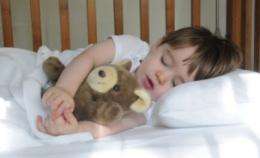
(PhysOrg.com) -- Hyperactive boys don't get enough sleep, which can worsen their condition according to new research. Published in the November issue of Pediatrics, the study is the first to examine a large sample of children and to study the link between lack of sleep and hyperactivity.

As part of the investigation, 2057 mothers answered yearly questionnaires concerning sleep duration and of their . Data was collected until kids reached five years of age and was analyzed by a team of scientists from the Université de Montréal, its affiliated Hôpital du Sacré-Cœur de Montréal and Sainte Justine University Hospital Research Center, as well as the Université Laval and the French National Institute for Health and Medical Research (INSERM).

“ Hyperactivity problems may interfere with night-time sleep,” says senior author Jacques Montplaisir, a professor in the Université de Montréal Department of Psychiatry and director of the Sleep Disorders Center at Hôpital du Sacré-Cœur de Montréal. “We found that children who didn't sleep long were generally hyperactive boys who lived under adverse family conditions.”

“On the other hand, short or fragmented sleep leads to sleepiness, which could manifest as hyperactivity in boys,” explains Dr. Montplaisir, noting children who slept persistently for at least 11 hours had low hyperactivity scores. “However, the risk of abbreviated sleep in highly hyperactive children is stronger than the risk of hyperactivity among kids with short sleep duration.”

The research team found that boys (more than girls) whose mothers had low education, insufficient family income and whom were comforted outside the bed or joined the parental bed after an awakening at night when they were young were more at risk of having both short sleep duration and high hyperactivity.

Study respondents were a mostly (92.1 percent) homogenous pool of mothers who were white and French-speaking Quebecers. Questions asked of mothers included: how long does your child during the night (on average); in the past three months, how often would you say your child was restless or hyperactive; couldn't stop fidgeting; impulsive or acted without thinking; had difficulty waiting for his/her turn at games; couldn't settle down to do anything or couldn't wait when promised something?”

More information: The article “Short Nighttime Sleep-Duration and Hyperactivity Trajectories in Early Childhood,” published in the journal Pediatrics, was authored by Evelyne Touchette, Bruno, Falissard of the INSERM, France, Michel Boivin, PhD of Université Laval and Sylvana M. Côté, Dominique Petit, Xuecheng Liu, Richard E. Tremblay and Jacques Y. Montplaisir of the Université de Montréal.

Provided by University of Montreal (news : web)


Rank 5 /5 (1 vote)
Related Stories
Relevant PhysicsForums posts
  • Is Everyday Technology Killing Us?
    createdFeb 08, 2012
  • Exercise and weight loss
    createdFeb 08, 2012
  • Why do we have head aches? Our brains can't feel anything.
    createdFeb 07, 2012
  • "The end of diseases" by David Agus, interview from Daily Show with Jon Stewart
    createdFeb 04, 2012
  • Oncolytic adenovirus
    createdFeb 04, 2012
  • Nutrition label stuffs and diets
    createdFeb 02, 2012
  • More from Physics Forums - Medical Sciences

More news stories

Study suggests girls can 'rewire' brains to ward off depression

(Medical Xpress) -- What if you could teach your brain to respond differently to things that make you feel sad, down or stressed out? What if doing that helped ward off depression?

Medicine & Health / Psychology & Psychiatry

created 9 minutes ago | popularity not rated yet | comments 0

UNC investigator issues call to action for schizophrenia research

(Medical Xpress) -- Much of medical research is aimed at figuring out what role a single gene or molecule plays in the development of disease.

Medicine & Health / Psychology & Psychiatry

created 4 minutes ago | popularity not rated yet | comments 0

What does love look like?

What does love look like? A dozen roses delivered on an ordinary weekday? Breakfast in bed? Or just a knowing glance between lovers?

Medicine & Health / Psychology & Psychiatry

created 3 minutes ago | popularity not rated yet | comments 0

High school students test best with 7 hours' rest

(Medical Xpress) -- Whether or not you know any high school students that actually get nine hours of sleep each night, that’s what federal guidelines currently prescribe.

Medicine & Health / Health

created 40 minutes ago | popularity not rated yet | comments 0

Using economic evaluations for drug reimbursement decisions - what have we achieved?

Researchers at the University of York perform evaluations of the clinical and cost-effectiveness of drugs for the National Institute for Health and Clinical Excellence (NICE).

Medicine & Health / Health

created 37 minutes ago | popularity not rated yet | comments 0


New error-correcting codes guarantee the fastest possible rate of data transmission

Error-correcting codes are one of the triumphs of the digital age. They’re a way of encoding information so that it can be transmitted across a communication channel — such as an optical fiber o ...

A frank discussion of the power law and linking correlation to causation

(PhysOrg.com) -- Michael Stumpf a mathematics professor at Imperial College in London, and Mason Porter a lecturer at Oxford have teamed together to write and publish a perspective piece in Science regarding the in ...

Mars Science Laboratory computer issue resolved

(PhysOrg.com) -- Engineers have found the root cause of a computer reset that occurred two months ago on NASA's Mars Science Laboratory and have determined how to correct it.

Advanced power-grid model finds low-cost, low-carbon future in West

(PhysOrg.com) -- The least expensive way for the Western U.S. to reduce greenhouse gas emissions enough to help prevent the worst consequences of global warming is to replace coal with renewable and other ...

Small modular reactor design could be a 'SUPERSTAR'

(PhysOrg.com) -- Though most of today's nuclear reactors are cooled by water, we've long known that there are alternatives; in fact, the world's first nuclear-powered electricity in 1951 came from a reactor ...

The question of life in the ancient world

There’s a general feeling that we don’t get the Greeks – ancient or modern. Many, including heads of state like Angela Merkel, visibly shake their head in exasperation, rightly or wrongly, at ...