Robots shed more light on evolution (w/ Video)
February 1, 2010 by Lin Edwards report
Evolution of homing

Enlarge

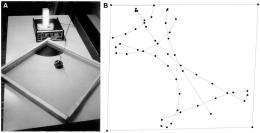
A) Experimental setup with a Khepera robot moving in the direction of the nest (recharging station), located in front of the light tower. B) Trajectory of an evolved robot after 200 generations. The trajectory starts in the lower left corner and ends within the recharging nest in the top left corner. Each point corresponds to the recording of the robot's position using an external tracking device. The arena and the recharging nest were plotted by manually positioning the robot along their contours. Image credit: doi:10.1371/journal.pbio.1000292.g003

(PhysOrg.com) -- Swiss scientists have proposed that if robots could evolve through natural selection the result would be robots that would help each other, cooperate, and be capable of hunting. Their experiments follow on from earlier studies reported by PhysOrg, which used robots to shed light on evolutionary processes.

Researchers Laurent Keller, from the University of Lausanne, and Dario Floreano of the École Polytechnique Fédérale de Lausanne studied Alice and Khepera robots controlled by input information from the robots’ sensors and neural networks. They loaded short basic instruction codes into the robots’ operating systems, with random variations that changed every generation, in "virtual mutations". To simulate , only the code for the most successful robots was selected and passed to the next generation of robots.

In one experiment they programmed robots with six sensors on one side and two on the other to navigate a maze. They then selected the robots most skilled at avoiding collisions. After fewer than 100 generations the robots could navigate through a complex maze without collisions, and had learned to keep the side with six sensors facing in the direction of travel.

This video is not supported by your browser at this time.

Evolution of collision-free navigation. In the initial generations, robots can hardly avoid walls (one robot even approaches objects). After 50 generations, robots can navigate around the looping maze without hitting the walls.

In another experiment they programmed groups of robots to push tokens along a wall to a marked area to win points. They selected the robots that gained the most points to pass their code on to the next generation. Over time altruistic behaviors were observed, in which robots sacrificed points if the entire group would benefit, and the robots cooperated to push larger tokens together to earn more points. As in nature, the robots followed the biological principle of kin selection, in which they only helped robots having the same code lineage.

This video is not supported by your browser at this time.

Evolved "Khepera" robot performing exploration and homing for battery recharge. The robot enters the recharging area approximately 2 seconds before full battery discharge.

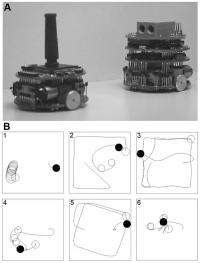
In other experiments some robots with good eyesight were programmed to pursue other robots, which were faster. At first the predators found the prey and headed towards it, while the prey were programmed to move away. After 125 generations, the predators had developed the strategy of lying in wait and attacking the prey robots’ blind spots, while the successful “prey” robots learned where the predators waited and ensured their sensors were always facing the predators.

This video is not supported by your browser at this time.

Coevolved predator and prey robots engaged in a tournament. After locating and moving towards the prey, the predator cannot reach it because the prey can perceive it with the rear distance sensors and moves faster.

The code used in the experiments was extremely short, which proves that complex behaviors can emerge from a simple set of instructions. The paper is published in the Public Library of Science -- Biology journal. Coevolution of predator and prey robots
Enlarge

A) The predator robot (right) facing the prey robot (left). B) Six examples of pursuit and evasion strategies that evolved over the 100 generations of selection in one of the replicates (see main text for description). The position of the prey at the end of the trial is indicated by the empty disk and that of the predator by the black disk (the lines in the disks correspond to the frontal directions). Image credit: doi:10.1371/journal.pbio.1000292.g004


More information: Floreano D, Keller L (2010) Evolution of Adaptive Behaviour in Robots by Means of Darwinian Selection. PLoS Biol 8(1): e1000292. doi:10.1371/journal.pbio.1000292

© 2010 PhysOrg.com

4.3 /5 (15 votes)  

Filter


Move the slider to adjust rank threshold, so that you can hide some of the comments.


Display comments: newest first

powercosmic
Feb 01, 2010

Rank: 4 / 5 (4)
Hey finite, too late, the US died a long time ago.

It was killed by Jerry Falwell, Pat Robertson, and the Christian Right.
Rank 4.3 /5 (15 votes)
Related Stories
Relevant PhysicsForums posts
  • feed hold button on CNC lathe
    created9 hours ago
  • Mechanics of Solids ( Final exam question) plz help!
    created11 hours ago
  • RFAC in Fortran
    created14 hours ago
  • dynamics 2/32
    created19 hours ago
  • dynamics
    created19 hours ago
  • Vibration Absorbtion Problem
    createdFeb 08, 2012
  • More from Physics Forums - General Engineering

More news stories

Barriers fall between TV, Internet

You say TV, I say Internet. Toe-mate-o, toe-mah-to.

Electronics / Consumer & Gadgets

created 44 minutes ago | popularity not rated yet | comments 0

Apple to debut 'iPad 3' in March: report

Apple will unveil a new version of its market-ruling iPad table computer in March, according to a report in Dow Jones-owned technology blog All Things D.

Electronics / Consumer & Gadgets

created 4 hours ago | popularity 2.4 / 5 (11) | comments 0

New Kindle Touch is an impressive e-reader

When it comes to reading digital books, tablets are all the rage. But there's a lot to like about simple e-readers, which over the past year have become both a lot cheaper and a lot less clunky.

Electronics / Consumer & Gadgets

created 4 hours ago | popularity 5 / 5 (1) | comments 0

Review: Soulo converts iPad into karaoke machine

Karaoke lovers typically fall into two categories: Those who enjoy it, and those whose arms have to be twisted to get up and sing in public.

Electronics / Consumer & Gadgets

created 22 hours ago | popularity not rated yet | comments 0

Google rumored to have built Heads-Up-Display glasses prototype

(PhysOrg.com) -- 9to5Google is reporting that they have received a tip from someone they believe to be a reliable source saying that Google is working on a Heads-Up-Display (HUD) pair of eye-glasses. The per ...

Electronics / Consumer & Gadgets

created Feb 08, 2012 | popularity 4.3 / 5 (8) | comments 2 | with audio podcast weblog


Hydrogen from acidic water: Researchers develop potential low cost alternative to platinum for splitting water

A technique for creating a new molecule that structurally and chemically replicates the active part of the widely used industrial catalyst molybdenite has been developed by researchers with the Lawrence Berkeley ...

Ultraviolet protection molecule in plants yields its secrets

Lying around in the sun all day is hazardous not just for humans but also for plants, which have no means of escape. Ultraviolet (UV) radiation from the sun can damage proteins and DNA inside cells, leading ...

To perform with less effort, practice beyond perfection

Whether you are an athlete, a musician or a stroke patient learning to walk again, practice can make perfect, but more practice may make you more efficient, according to a surprising new University of Colorado Boulder study.

Scientists identify most lethal known species of prion protein

Scientists from the Florida campus of The Scripps Research Institute have identified a single prion protein that causes neuronal death similar to that seen in "mad cow" disease, but is at least 10 times more ...

Researchers weigh in on ethics of H5N1 research

(Medical Xpress) -- In a commentary on the biosecurity controversy surrounding publication of bird flu research details, a bioethicist and a vaccine expert at Johns Hopkins reaffirm that "all scientists have an affirmativ ...

Deconstructing a mystery: What caused Snowmaggedon?

In the quiet after the storms, streets and cars had all but disappeared under piles of snow. The U.S. Postal Service suspended service for the first time in 30 years. Snow plows struggled to push the evidence ...