Heads-Up Virtual Reality (HUVR) Bridges Visual with Tactile, in 3D and on the Cheap
July 19, 2010 By Tiffany Fox
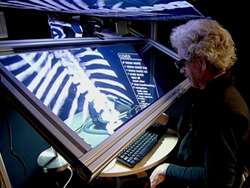
Calit2 Virtual Reality Design Engineer Greg Dawe demonstrates the HUVR device, which combines a consumer 3D HDTV panel, a half-silvered mirror and a touch-feedback controller that allows users to literally ‘touch’ a generated image as if it was a tangible three-dimensional object.
(PhysOrg.com) -- Researchers at the University of California, San Diego, have created a new, relatively low-cost virtual reality device that allows users not only to see a 3D image, but 'feel' it, too.
The Heads-Up Virtual Reality device (or HUVR, pronounced ‘hover’) couples a consumer 3D HDTV panel with a half-silvered mirror to project any graphic image onto the user’s hands and/or into the space surrounding them. With his or her head position tracked to generate the correct perspective view, the user maneuvers a touch-feedback (haptic) device to interact with the generated image, literally ‘touching’ the image’s angles and contours as if it was a tangible three-dimensional object.
HUVR is ideal for tasks that require hand-eye coordination and is well-suited to training and education in structural and mechanical engineering, archaeology and medicine. The device could be used, for example, to visualize and manipulate a 3-D image of a person’s brain taken from an MRI, or an artifact too fragile or precious to be physically handled.
“By using HUVR’s touch-feedback device - which is similar to a commercial game control — a physician could actually feel a defect in the brain, rather than merely see it,” explained Research Scientist Tom DeFanti. DeFanti, who is affiliated with the UC San Diego division of the California Institute for Telecommunications and Information Technology (Calit2), created the device with Calit2’s Virtual Reality Design Engineer Greg Dawe. And, DeFanti added, “this can be done over the networks, sharing the look and feel of the object with other researchers and students.”
A re-engineering of work done by Bell Labs’ Ken Knowlton more than 30 years ago (as well as later systems made by many researchers with 21” cathode ray tube monitors), HUVR also evolved from PARIS, a system created 12 years ago by DeFanti, Dawe and their colleagues and students at the Electronic Visualization Laboratory, University of Illinois, Chicago.
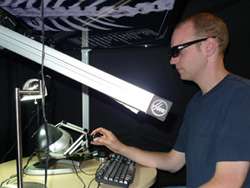
Calit2 VIsualization Specialist Andrew Prudhomme manipulates HUVR's force-feedback controller. A less expensive, re-engineered version of 30-year-old technology, HUVR could be used to visualize and manipulate a 3-D image of a person’s brain taken from an MRI, or an artifact too fragile or precious to be physically handled.
PARIS, or Personal Augmented Reality Interactive System, used a projection technology similar to HUVR, but was low-resolution, too big to move, and expensive. It required the Silicon Graphics, Inc. computers of the time to render the images and cost upwards of $100,000 (PARIS is still in operation today, but is now driven by a game PC).
The recent availability of 55” active stereo panel TVs was the key to making HUVR, which is essentially a more lightweight, portable, and - at about $7,000 (without head tracking) - a much cheaper version of the PARIS-based technology. Constructed from a $2300 Samsung 3DTV panel available at most retail electronics stores, HUVR also offers better brightness, contrast, and visual acuity than PARIS, all of which increase user satisfaction.
Although passive stereo 3D HDTVs have been available for about a year - allowing DeFanti and Dawe to build a new VR device called NexCave - active stereo is needed for HUVR. Active stereo generates separate left- and right-eye images that can bounce off mirrors and are separated into left- and right-eye views by the user’s active eyewear, which blink in synchrony with the 3D HDTV’s 120Hz images. The polarization used in passive stereo will not stay polarized when reflected off a mirror, hence the need for active stereo in HUVR and its precedents.
Video: NexCAVE: High-Definition Virtual Reality
The next step in HUVR’s evolution is to create a less expensive, reasonable quality head tracker suited to a desktop device (commercially available trackers currently range from $5,000 to $20,000).
Provided by University of California - San Diego (news : web)
-
Modified HDTV screens used for 3-D technology (w/ Video)
Aug 18, 2009 |
not rated yet |
0
-
3D without the glasses: introducing pCubee (w/ Video)
Mar 31, 2010 |
not rated yet |
0
-
Samsung Intros 3D Game Phones with Vibration
Apr 08, 2005 |
not rated yet |
0
-
IMAX On the Desktop with Kodak Breakthrough Next-Generation 3D Stereo Display
Aug 10, 2004 |
not rated yet |
0
-
Fingertip Device Helps Computers Read Hand Gestures
Jul 27, 2006 |
not rated yet |
0
-
Engineers build first sub-10-nm carbon nanotube transistor
Feb 01, 2012 |
4.9 / 5 (31) |
30
-
Something old, something new: Evolution and the structural divergence of duplicate genes
Jan 31, 2012 |
4.6 / 5 (7) |
1
-
The hidden nanoworld of ice crystals: Revealing the dynamic behavior of quasi-liquid layers
Jan 30, 2012 |
5 / 5 (3) |
1
-
Stock market network reveals investor clustering
Jan 27, 2012 |
3.9 / 5 (23) |
8
-
Of microchemistry and molecules: Electronic microfluidic device synthesizes biocompatible probes
Jan 26, 2012 |
5 / 5 (1) |
0
-
Calling function with no input argument
13 hours ago
-
Force free body diagram problem on gym equipment
14 hours ago
-
Empirical data regarding shower heads and water
22 hours ago
-
feed hold button on CNC lathe
Feb 09, 2012
-
RFAC in Fortran
Feb 09, 2012
-
dynamics 2/32
Feb 08, 2012
- More from Physics Forums - General Engineering
More news stories
Google users warned of threat to smartphone wallets
Users of Google smartphone wallets were being warned on Friday that there is a way to crack pass codes intended to thwart thieves from going on illicit shopping sprees.
6 hours ago |
5 / 5 (2) |
0
Anonymous knocks CIA website offline (Update)
The website of the Central Intelligence Agency was inaccessible on Friday after the hacker group Anonymous claimed to have knocked it offline.
8 hours ago |
5 / 5 (8) |
13
New error-correcting codes guarantee the fastest possible rate of data transmission
Error-correcting codes are one of the triumphs of the digital age. Theyre a way of encoding information so that it can be transmitted across a communication channel such as an optical fiber o ...
Technology / Computer Sciences
16 hours ago |
4.9 / 5 (8) |
6
|
New power source discovered
(PhysOrg.com) -- Researchers at the Massachusetts Institute of Technology (MIT) and RMIT University have made a breakthrough in energy storage and power generation.
Technology / Energy & Green Tech
15 hours ago |
4.8 / 5 (25) |
8
|
Small modular reactor design could be a 'SUPERSTAR'
(PhysOrg.com) -- Though most of today's nuclear reactors are cooled by water, we've long known that there are alternatives; in fact, the world's first nuclear-powered electricity in 1951 came from a reactor ...
Technology / Energy & Green Tech
16 hours ago |
4.3 / 5 (12) |
22
|
Humans may have helped the decline of African rainforests 3000 years ago
(PhysOrg.com) -- Large areas of rainforests in Central Africa mysteriously disappeared over three thousand years ago, to be replaced by savannas. The prevailing theory has been that the cause was a change ...
Complex wiring of the nervous system may rely on a just a handful of genes and proteins
Researchers at the Salk Institute have discovered a startling feature of early brain development that helps to explain how complex neuron wiring patterns are programmed using just a handful of critical genes. ...
The power of estrogen -- male snakes attract other males
A new study has shown that boosting the estrogen levels of male garter snakes causes them to secrete the same pheromones that females use to attract suitors, and turned the males into just about the sexiest ...
Putting the squeeze on planets outside our solar system
(PhysOrg.com) -- Using high-powered lasers, scientists at Lawrence Livermore National Laboratory and collaborators discovered that molten magnesium silicate undergoes a phase change in the liquid state, abruptly ...
Could Venus be shifting gear?
(PhysOrg.com) -- ESAs Venus Express spacecraft has discovered that our cloud-covered neighbour spins a little slower than previously measured. Peering through the dense atmosphere in the infrared, the ...
Fool's gold may prove an unlikely alternative to overexploited catalytic materials
Catalytic materials, which lower the energy barriers for chemical reactions, are used in everything from the commercial production of chemicals to catalytic converters in car engines. However, with current catalytic materials ...