Brilliant Star in a Colourful Neighbourhood
July 28, 2010
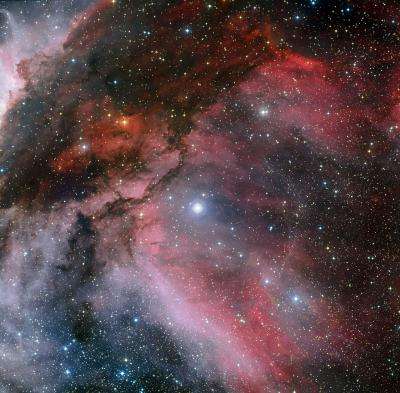
This image of part of the Carina Nebula was created from images taken through red, green and blue filters with the Wide Field Imager on the MPG/ESO 2.2-meter telescope at ESO’s La Silla Observatory in Chile. It is centered on the unusual hot massive young star WR 22, a member of the rare class of Wolf-Rayet stars. The field of view is 0.55 x 0.55 degrees, covering a 72 x 72 light-year region at the distance of the nebula. Credit: ESO
A spectacular new image from ESO's Wide Field Imager at the La Silla Observatory in Chile shows the brilliant and unusual star WR 22 and its colorful surroundings. WR 22 is a very hot and bright star that is shedding its atmosphere into space at a rate many millions of times faster than the Sun. It lies in the outer part of the dramatic Carina Nebula from which it formed.
Very massive stars live fast and die young. Some of these stellar beacons have such intense radiation passing through their thick atmospheres late in their lives that they shed material into space many millions of times more quickly than relatively sedate stars such as the Sun. These rare, very hot and massive objects are known as Wolf-Rayet stars, after the two French astronomers who first identified them in the mid-nineteenth century, and one of the most massive ones yet measured is known as WR 22.
It appears at the centre of this picture, which was created from images taken through red, green and blue filters with the Wide Field Imager on the MPG/ESO 2.2-metre telescope at ESO's La Silla Observatory in Chile. WR 22 is a member of a double star system and has been measured to have a mass at least 70 times that of the Sun.
WR 22 lies in the southern constellation of Carina, the keel of Jason's ship Argo in Greek mythology. Although the star lies over 5000 light-years from the Earth it is so bright that it can just be faintly seen with the unaided eye under good conditions. WR 22 is one of many exceptionally brilliant stars associated with the beautiful Carina Nebula (also known as NGC 3372) and the outer part of this huge region of star formation in the southern Milky Way forms the colourful backdrop to this image.
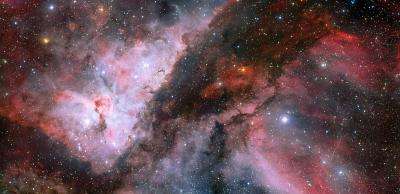
The subtle colours of the rich background tapestry are a result of the interactions between the intense ultraviolet radiation coming from hot massive stars, including WR 22, and the vast gas clouds, mostly hydrogen, from which they formed. The central part of this enormous complex of gas and dust lies off the left side of this picture as can be seen in image below. This area includes the remarkable star Eta Carinae.
Enlarge
This spectacular panoramic view combines a new image of the field around the Wolf-Rayet star WR 22 in the Carina Nebula (right) with an earlier picture of the region around the unique star Eta Carinae in the heart of the nebula (left). The picture was created from images taken with the Wide Field Imager on the MPG/ESO 2.2-metre telescope at ESO’s La Silla Observatory in Chile. Credit: ESO
-
Strong winds over the keel
Feb 12, 2009 |
not rated yet |
0
-
A sparkling spray of stars
Dec 16, 2008 |
not rated yet |
0
-
On the Trail of a Cosmic Cat (w/ Video)
Jan 20, 2010 |
not rated yet |
0
-
R Coronae Australis: A cosmic watercolor (w/ Video)
Jun 30, 2010 |
not rated yet |
0
-
Hubble snaps sharp image of cosmic concoction (w/ Video)
Jul 13, 2010 |
not rated yet |
0
-
Engineers build first sub-10-nm carbon nanotube transistor
Feb 01, 2012 |
4.9 / 5 (30) |
30
-
Something old, something new: Evolution and the structural divergence of duplicate genes
Jan 31, 2012 |
4.6 / 5 (7) |
1
-
The hidden nanoworld of ice crystals: Revealing the dynamic behavior of quasi-liquid layers
Jan 30, 2012 |
5 / 5 (3) |
1
-
Stock market network reveals investor clustering
Jan 27, 2012 |
3.9 / 5 (23) |
8
-
Of microchemistry and molecules: Electronic microfluidic device synthesizes biocompatible probes
Jan 26, 2012 |
5 / 5 (1) |
0
-
Titan's lack of impact craters
Feb 09, 2012
-
Real pictures of black hole eating a star?
Feb 08, 2012
-
Hypothetical way to travel faster than light, but not technically exceed lightspeed
Feb 06, 2012
-
How do scientists monitor the Sun's activity?
Feb 05, 2012
-
Search patterns in observational studies
Feb 05, 2012
-
Derivation of Pogson's law
Feb 03, 2012
- More from Physics Forums - General Astronomy
More news stories
Could Venus be shifting gear?
(PhysOrg.com) -- ESAs Venus Express spacecraft has discovered that our cloud-covered neighbour spins a little slower than previously measured. Peering through the dense atmosphere in the infrared, the ...
Space & Earth / Space Exploration
4 hours ago |
5 / 5 (5) |
7
|
Humans may have helped the decline of African rainforests 3000 years ago
(PhysOrg.com) -- Large areas of rainforests in Central Africa mysteriously disappeared over three thousand years ago, to be replaced by savannas. The prevailing theory has been that the cause was a change ...
Mars Science Laboratory computer issue resolved
(PhysOrg.com) -- Engineers have found the root cause of a computer reset that occurred two months ago on NASA's Mars Science Laboratory and have determined how to correct it.
Space & Earth / Space Exploration
5 hours ago |
5 / 5 (5) |
3
|
Clam fields found at deep, low-temperature Mariana vents
(PhysOrg.com) -- Scientists have marveled at the unusual life forms thriving at high temperature hydrothermal vents of the deep ocean.
Space & Earth / Earth Sciences
5 hours ago |
not rated yet |
0
|
Two new moons for Jupiter
Advances in technology have lead to the discovery of new planets outside of our Solar System, and now even new moons in our own backyard.
Space & Earth / Space Exploration
4 hours ago |
not rated yet |
2
Putting the squeeze on planets outside our solar system
(PhysOrg.com) -- Using high-powered lasers, scientists at Lawrence Livermore National Laboratory and collaborators discovered that molten magnesium silicate undergoes a phase change in the liquid state, abruptly ...
India probes Google over 'forex transactions'
Indian authorities are probing whether online giant Google broke domestic foreign-exchange transactions rules while shifting funds abroad, the Press Trust of India reported on Friday.
Germany freezes signing of disputed Internet pact
Germany on Friday halted the signing of a controversial international accord billed as a way to beat online piracy that has sparked angry protests, saying it needed more time to consider it.
Health experts, scientists to discuss bird flu studies
The World Health Organization said Friday it will meet next week to determine whether scientists can publish research on a bird flu virus that may be easily passed among humans.
Employers feel no love for unscrupulous practice of 'service sweethearting'
A new study led by two Florida State University marketing professors finds that some frontline service employees who are rewarded for hikes in customer loyalty and satisfaction also may engage in "service ...
Obama forges compromise birth control plan
US President Barack Obama Friday announced a compromise to defuse a row over access to birth control which prompted election-year Republican critics to claim he was waging a war on religion.
Jul 29, 2010
Rank: 2 / 5 (1)
Observations like this will eventually confirm or deny our theories about the formation of stars!
With kind regards,
Oliver K. Manuel
Former NASA Principal
Investigator for Apollo
Jul 29, 2010
Rank: 1.7 / 5 (3)