High-speed filter uses electrified nanostructures to purify water at low cost
August 31, 2010 By Louis Bergeron
High-speed filter uses electrified nanostructures to purify water at low cost

Enlarge

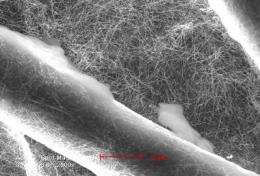
This scanning electron microscope image shows the silver nanowires in which the cotton is dipped during the process of constructing a filter. The large fibers are cotton. Credit: Courtesy of Yi Cui, Stanford University

(PhysOrg.com) -- By dipping plain cotton cloth in a high-tech broth full of silver nanowires and carbon nanotubes, Stanford researchers have developed a new high-speed, low-cost filter that could easily be implemented to purify water in the developing world.

Instead of physically trapping as most existing filters do, the new filter lets them flow on through with the water. But by the time the have passed through, they have also passed on, because the device kills them with an that runs through the highly conductive "nano-coated" cotton.

In lab tests, over 98 percent of bacteria that were exposed to 20 volts of electricity in the filter for several seconds were killed. Multiple layers of fabric were used to make the filter 2.5 inches thick.

"This really provides a new water treatment method to kill pathogens," said Yi Cui, an associate professor of materials science and engineering. "It can easily be used in remote areas where people don't have access to chemical treatments such as chlorine."

Cholera, typhoid and hepatitis are among the waterborne diseases that are a continuing problem in the developing world. Cui said the new filter could be used in water purification systems from cities to small villages.

Faster filtering by letting bacteria through

Filters that physically trap bacteria must have pore spaces small enough to keep the pathogens from slipping through, but that restricts the filters' flow rate.

Since the new filter doesn't trap bacteria, it can have much larger pores, allowing water to speed through at a more rapid rate.

"Our filter is about 80,000 times faster than filters that trap bacteria," Cui said. He is the senior author of a paper describing the research that will be published in an upcoming issue of . The paper is available online now.

The larger pore spaces in Cui's filter also keep it from getting clogged, which is a problem with filters that physically pull bacteria out of the water.

Cui's research group teamed with that of Sarah Heilshorn, an assistant professor of materials science and engineering, whose group brought its bioengineering expertise to bear on designing the filters.

Silver has long been known to have chemical properties that kill bacteria. "In the days before pasteurization and refrigeration, people would sometimes drop silver dollars into milk bottles to combat bacteria, or even swallow it," Heilshorn said.

Cui's group knew from previous projects that carbon nanotubes were good electrical conductors, so the researchers reasoned the two materials in concert would be effective against bacteria. "This approach really takes silver out of the folk remedy realm and into a high-tech setting, where it is much more effective," Heilshorn said.

Using the commonplace keeps costs down

But the scientists also wanted to design the filters to be as inexpensive as possible. The amount of silver used for the was so small the cost was negligible, Cui said. Still, they needed a foundation material that was "cheap, widely available and chemically and mechanically robust." So they went with ordinary woven cotton fabric.

"We got it at Wal-mart," Cui said.

To turn their discount store cotton into a filter, they dipped it into a solution of carbon nanotubes, let it dry, then dipped it into the silver nanowire solution. They also tried mixing both nanomaterials together and doing a single dunk, which also worked. They let the cotton soak for at least a few minutes, sometimes up to 20, but that was all it took.

The big advantage of the nanomaterials is that their small size makes it easier for them to stick to the cotton, Cui said. The nanowires range from 40 to 100 billionths of a meter in diameter and up to 10 millionths of a meter in length. The nanotubes were only a few millionths of a meter long and as narrow as a single billionth of a meter. Because the nanomaterials stick so well, the nanotubes create a smooth, continuous surface on the cotton fibers. The longer nanowires generally have one end attached with the nanotubes and the other end branching off, poking into the void space between cotton fibers.

"With a continuous structure along the length, you can move the electrons very efficiently and really make the filter very conducting," he said. "That means the filter requires less voltage."

Minimal electricity required

The electrical current that helps do the killing is only a few milliamperes strong - barely enough to cause a tingling sensation in a person and easily supplied by a small solar panel or a couple 12-volt car batteries. The electrical current can also be generated from a stationary bicycle or by a hand-cranked device.

The low electricity requirement of the new filter is another advantage over those that physically filter bacteria, which use electric pumps to force water through their tiny pores. Those pumps take a lot of electricity to operate, Cui said.

In some of the lab tests of the nano-filter, the electricity needed to run current through the filter was only a fifth of what a filtration pump would have needed to filter a comparable amount of water.

The pores in the nano-filter are large enough that no pumping is needed - the force of gravity is enough to send the water speeding through.

Although the new filter is designed to let bacteria pass through, an added advantage of using the silver nanowire is that if any bacteria were to linger, the silver would likely kill it. This avoids biofouling, in which bacteria form a film on a filter. Biofouling is a common problem in filters that use small pores to filter out bacteria.

Cui said the electricity passing through the conducting filter may also be altering the pH of the water near the filter surface, which could add to its lethality toward the bacteria.

Cui said the next steps in the research are to try the filter on different types of bacteria and to run tests using several successive .

"With one filter, we can kill 98 percent of the bacteria," Cui said. "For drinking water, you don't want any live bacteria in the water, so we will have to use multiple filter stages."

Cui's research group has gained attention recently for using nanomaterials to build batteries from paper and cloth.

More information: Research paper on Nano Letters website - http://pubs.acs.or … 21/nl101944e

Provided by Stanford University (news : web)

4.9 /5 (22 votes)  

Filter


Move the slider to adjust rank threshold, so that you can hide some of the comments.


Display comments: newest first

Magus
Aug 31, 2010

Rank: 5 / 5 (2)
Mmmm, dead bacteria. But seriously awesome.
DaveGee
Aug 31, 2010

Rank: 4 / 5 (1)
While I too applaud the work I'm kinda left wondering why this has to be done at the nano level at all? If silver combined with a current is enough to kill 98% of the nasties then why not do it at normal scale? Wouldn't a screen fashioned from silver also remove the cotton from the equation.... Which at first reading is just a support mechanism for the silver nano wires?
Sciencebee
Aug 31, 2010

Rank: 5 / 5 (2)
I believe the point of using the nano silver is they are able to use much less of it. Smaller strands of the silver means more surface area interacting with the bacteria. Water filtration techniques are usually focused on cost as many of the people who need clean water do not have much income if any.
feynmansum
Aug 31, 2010

Rank: 5 / 5 (2)
Small amount of silver for nanowires, not expensive, growing silver nanowires in the lab, expensive. I understand the scale increases the surface area, and even silver nanoparticles without voltage are toxic to microorganisms, but what makes them think a person who can't get their hands on some disinfectant or a hand-pump water filter will have 20 volts to plug into? Apparently their target audience has solar panels, or a stationary bike replete with alternator, but no chlorine?
On a more positive note, I like the anti-fouling aspect of the design.
Caliban
Aug 31, 2010

Rank: 2.8 / 5 (4)
Two caveats:

1. Doesn't nanosilver create a secondary environmental risk, once it is released into the environment? This would be an unavoidable consequence of use.

2. Aren't chemical impurities going to plate out onto the silver and/or carbon? Won't this lead to fouling/reduced effectiveness?
scidog
Aug 31, 2010

Rank: 1.7 / 5 (3)
i'm sure some clever person could come up with a way to have the water falling freely thru the filter turn a turbine that would make the electric power needed.
tarheelchief
Sep 01, 2010

Rank: not rated yet
The most common reason for hospitalization overseas is dirty water.This will not only help rural areas it will be a godsend to the urban areas where water is available,but filthy.
callywally
Sep 01, 2010

Rank: not rated yet
Very innovative idea! Anti-biofouling and disinfecting filter, that's new. It can possibly be cheaper than UV, ozone etc. for water disinfection in any potable water plant. But excuse me, do we have a cheap and high-volume process for carbon nanotubes already?
eurekalogic
Sep 02, 2010

Rank: 5 / 5 (1)
While I too applaud the work I'm kinda left wondering why this has to be done at the nano level at all? If silver combined with a current is enough to kill 98% of the nasties then why not do it at normal scale? Wouldn't a screen fashioned from silver also remove the cotton from the equation.... Which at first reading is just a support mechanism for the silver nano wires?


No electricity is needed to kill bacteria with silver. The electricity is to prevent the silver from degrading. Similar to cathodic protection. I dont know why they are cryptic about how it really works.
IgorIP
Sep 02, 2010

Rank: not rated yet
There is patent related with this, exploiting electric properties of silver nanoparticles... http://www.wipo.i...Y=STATUS
ithinkican
Sep 04, 2010

Rank: 5 / 5 (1)
As I remember it, the 'jury is still out' regarding the safety of nano sized particles, and the effects on the human body are not fully quantified. It seems reckless to offer to this to impoverished peoples to Drink this on a daily basis. Guinea pigs anyone?
rgharakh
Sep 05, 2010

Rank: not rated yet
The electrified carbon nanotubes are the ones doing most of the direct killing of bacteria. The silver nanotubes are there to prevent biofowling as well as kill bacteria. If you put a disk of this stuff in a water bottle with a solar panel attached to it, you can filter water quickly. Great for outdoorsy people
Rank 4.9 /5 (22 votes)
Relevant PhysicsForums posts

More news stories

'Dark plasmons' transmit energy

Microscopic channels of gold nanoparticles have the ability to transmit electromagnetic energy that starts as light and propagates via "dark plasmons," according to researchers at Rice University.

Nanotechnology / Nanophysics

created 10 hours ago | popularity 5 / 5 (4) | comments 0 | with audio podcast

Nanotube therapy takes aim at breast cancer stem cells

Wake Forest Baptist Medical Center researchers have again proven that injecting multiwalled carbon nanotubes (MWCNTs) into tumors and heating them with a quick, 30-second laser treatment can kill them.

Nanotechnology / Bio & Medicine

created 15 hours ago | popularity 5 / 5 (1) | comments 0 | with audio podcast

Inspired by steel, nanomanufacturing gets wear-resistant carbide tip

(PhysOrg.com) -- Scientists at the University of Pennsylvania, the University of Wisconsin-Madison and IBM Research - Zurich have fabricated an ultrasharp silicon carbide tip possessing such high strength ...

Nanotechnology / Nanophysics

created 20 hours ago | popularity 5 / 5 (3) | comments 1 | with audio podcast

New technology platform for molecule-based electronics

Researchers at the Nano-Science Center at the University of Copenhagen have developed a new nano-technology platform for the development of molecule-based electronic components using the wonder material graphene. At the same ...

Nanotechnology / Nanomaterials

created 17 hours ago | popularity 5 / 5 (2) | comments 0

New kind of solar cell could capture significantly more energy than current cells

New solar cells could increase the maximum efficiency of solar panels by over 25%, according to scientists from the University of Cambridge.

Nanotechnology / Nanophysics

created Feb 08, 2012 | popularity 4.5 / 5 (11) | comments 14 | with audio podcast


FDA-approved drug rapidly clears amyloid from the brain, reverses Alzheimer's symptoms in mice

Neuroscientists at Case Western Reserve University School of Medicine have made a dramatic breakthrough in their efforts to find a cure for Alzheimer's disease. The researchers' findings, published in the journal Science, show t ...

Hydrogen from acidic water: Researchers develop potential low cost alternative to platinum for splitting water

A technique for creating a new molecule that structurally and chemically replicates the active part of the widely used industrial catalyst molybdenite has been developed by researchers with the Lawrence Berkeley ...

Ultraviolet protection molecule in plants yields its secrets

Lying around in the sun all day is hazardous not just for humans but also for plants, which have no means of escape. Ultraviolet (UV) radiation from the sun can damage proteins and DNA inside cells, leading ...

Soraa LED light may dim 50-watt halogen rivals

(PhysOrg.com) -- Soraa, a Fremont, California company founded in 2008, this week launched its first product, a light that uses LEDS (light emitting diodes). The "Soraa LED MR16 lamp" is the "perfect" replacement ...

Anyone can learn to be more inventive, cognitive researcher says

There will always be a wild and unpredictable quality to creativity and invention, says Anthony McCaffrey, a cognitive psychology researcher at the University of Massachusetts Amherst, because an "Aha moment" is rare and ...

Engineers find inspiration for new materials in Piranha-proof armor

(PhysOrg.com) -- It’s a matchup worthy of a late-night cable movie: put a school of starving piranha and a 300-pound fish together, and who comes out the winner?