Silicon oxide circuits break barrier: Nanocrystal conductors could lead to massive, robust 3-D storage
August 31, 2010
Silicon oxide circuits break barrier

Enlarge

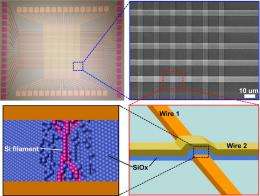
A 1k silicon oxide memory has been assembled by Rice and a commercial partner as a proof-of-concept. Silicon nanowire forms when charge is pumped through the silicon oxide, creating a two-terminal resistive switch. (Images courtesy Jun Yao/Rice University)

Rice University scientists have created the first two-terminal memory chips that use only silicon, one of the most common substances on the planet, in a way that should be easily adaptable to nanoelectronic manufacturing techniques and promises to extend the limits of miniaturization subject to Moore's Law.

Last year, researchers in the lab of Rice Professor James Tour showed how could repeatedly break and reconnect 10-nanometer strips of graphite, a form of carbon, to create a robust, reliable memory "bit." At the time, they didn't fully understand why it worked so well.

Now, they do. A new collaboration by the Rice labs of professors Tour, Douglas Natelson and Lin Zhong proved the circuit doesn't need the carbon at all.

Jun Yao, a graduate student in Tour's lab and primary author of the paper to appear in the online edition of , confirmed his breakthrough idea when he sandwiched a layer of , an , between semiconducting sheets of that served as the top and bottom electrodes.

Applying a charge to the electrodes created a conductive pathway by stripping oxygen atoms from the silicon oxide and forming a chain of nano-sized silicon crystals. Once formed, the chain can be repeatedly broken and reconnected by applying a pulse of varying voltage.

The nanocrystal wires are as small as 5 wide, far smaller than circuitry in even the most advanced computers and electronic devices.

"The beauty of it is its simplicity," said Tour, Rice's T.T. and W.F. Chao Chair in Chemistry as well as a professor of mechanical engineering and materials science and of computer science. That, he said, will be key to the technology's scalability. Silicon oxide switches or memory locations require only two terminals, not three (as in flash memory), because the physical process doesn't require the device to hold a charge.

It also means layers of silicon-oxide memory can be stacked in tiny but capacious three-dimensional arrays. "I've been told by industry that if you're not in the 3-D memory business in four years, you're not going to be in the memory business. This is perfectly suited for that," Tour said.

Silicon-oxide memories are compatible with conventional transistor manufacturing technology, said Tour, who recently attended a workshop by the National Science Foundation and IBM on breaking the barriers to Moore's Law, which states the number of devices on a circuit doubles every 18 to 24 months.

"Manufacturers feel they can get pathways down to 10 nanometers. is going to hit a brick wall at about 20 nanometers. But how do we get beyond that? Well, our technique is perfectly suited for sub-10-nanometer circuits," he said.

Austin tech design company PrivaTran is already bench testing a silicon-oxide chip with 1,000 memory elements built in collaboration with the Tour lab. "We're real excited about where the data is going here," said PrivaTran CEO Glenn Mortland, who is using the technology in several projects supported by the Army Research Office, National Science Foundation, Air Force Office of Scientific Research, and the Navy Space and Naval Warfare Systems Command Small Business Innovation Research (SBIR) and Small Business Technology Transfer programs.

"Our original customer funding was geared toward more high-density memories," Mortland said. "That's where most of the paying customers see this going. I think, along the way, there will be side applications in various nonvolatile configurations."

Yao had a hard time convincing his colleagues that silicon oxide alone could make a circuit. "Other group members didn't believe him," said Tour, who added that nobody recognized silicon oxide's potential, even though it's "the most-studied material in human history."

"Most people, when they saw this effect, would say, 'Oh, we had silicon-oxide breakdown,' and they throw it out," he said. "It was just sitting there waiting to be exploited."

In other words, what used to be a bug turned out to be a feature.

Yao went to the mat for his idea. He first substituted a variety of materials for graphite and found none of them changed the circuit's performance. Then he dropped the carbon and metal entirely and sandwiched silicon oxide between silicon terminals. It worked.

"It was a really difficult time for me, because people didn't believe it," Yao said. Finally, as a proof of concept, he cut a carbon nanotube to localize the switching site, sliced out a very thin piece of silicon oxide by focused ion beam and identified a nanoscale silicon pathway under a transmission electron microscope.

"This is research," Yao said. "If you do something and everyone nods their heads, then it's probably not that big. But if you do something and everyone shakes their heads, then you prove it, it could be big.

"It doesn't matter how many people don't believe it. What matters is whether it's true or not."

Silicon-oxide circuits carry all the benefits of the previously reported graphite device. They feature high on-off ratios, excellent endurance and fast switching (below 100 nanoseconds).

They will also be resistant to radiation, which should make them suitable for military and NASA applications. "It's clear there are lots of radiation-hardened uses for this technology," Mortland said.

Silicon oxide also works in reprogrammable gate arrays being built by NuPGA, a company formed last year through collaborative patents with Rice University. NuPGA's devices will assist in the design of computer circuitry based on vertical arrays of silicon oxide embedded in "vias," the holes in integrated circuits that connect layers of . Such rewritable gate arrays could drastically cut the cost of designing complex .

More information: http://pubs.acs.or … 21/nl102255r

Provided by Rice University (news : web)

4.9 /5 (36 votes)  

Filter


Move the slider to adjust rank threshold, so that you can hide some of the comments.


Display comments: newest first

Palli
Aug 31, 2010

Rank: 1.3 / 5 (4)

They will also be resistant to radiation, which should make them suitable for military and NASA applications. "It's clear there are lots of radiation-hardened uses for this technology," Mortland said.

...And that's the last we'll hear of this tech for the next couple of decades.. *sigh*
Simon_Dufour
Aug 31, 2010

Rank: not rated yet
Ok now they should try to make real memory out of it.
SteveL
Aug 31, 2010

Rank: 4.8 / 5 (6)

They will also be resistant to radiation, which should make them suitable for military and NASA applications. "It's clear there are lots of radiation-hardened uses for this technology," Mortland said.

...And that's the last we'll hear of this tech for the next couple of decades.. *sigh*


This should be where things start. Quite a bit of our modern technology started as military or space research. I can't count how many times we keep hitting technological "limits". Many throw up thier hands in frustration, a few push on and somehow, someone keeps advancing the boundaries.

While I'm not the one sweating out the research, I sure don't mind enjoying their results. What was a facinating discovery yesterday is commonplace today. I can only imagine what the tomorrows will bring.
A_Paradox
Aug 31, 2010

Rank: 5 / 5 (3)

...And that's the last we'll hear of this tech for the next couple of decades.. *sigh*


Ok now they should try to make real memory out of it


given the relative simplicity of the idea and the fact they already have the proof-of concept design working, I don't see any particular reason for despondency. I think the potential for robust miniaturisation and potential for much reduced energy consumption should see this developed commercially.
The way I understand the article, the silicon 'nanowires' are stable over relatively long periods so current is only necessary for reading or writing each junction. That will still cause entropic heating so it will be fascinating to see how many layers can be stacked in each chip. The NASA/space applications will encourage very sophisticated uses.
rgwalther
Aug 31, 2010

Rank: not rated yet

And that's the last we'll hear of this tech for the next couple of decades.. *sigh*

rgwalther
Aug 31, 2010

Rank: 5 / 5 (8)
Yes, such a shame. If only the military had let us know about radar and jets and lasers and digital circuitry and nanotech and nuclear power. If all of this tech had not been so cleverly hidden by the evil military, we could have given up riding in ox carts and flown in heavier than air machines! The knotted rope and abacus would relics of the past. We could play music from shiny disks rather than the occasional band concert. Even better we would not be speaking German. Damn military, always abusing us.
Lordjavathe3rd
Aug 31, 2010

Rank: not rated yet
Does anyone think this will break the terabyte limit for personal computer memory?
dirk_bruere
Aug 31, 2010

Rank: not rated yet
The real limits to Moore's Law is the lithography, not the memory or transistor technology. Memristors work down to at least 4nm, this down to at least 10nm. But there exists no fabrication technology that can mass produce these even if the underlying technology was totally understood.
Rank 4.9 /5 (36 votes)
Relevant PhysicsForums posts
  • Are space and time things?
    created5 hours ago
  • Lock Magnet
    created8 hours ago
  • Neutrino interaction/detection?
    created12 hours ago
  • If an atom was scaled up to the size of a sports oval with a diameter of 150m...?
    created14 hours ago
  • Why no noise is added when we hear someone's voice from the other side of a wall?
    created16 hours ago
  • Force components between two bodies
    created21 hours ago
  • More from Physics Forums - General Physics

More news stories

Photovoltaic panels made from plant material could become a cheap alternative to traditional solar cells

Within a few years, people in remote villages in the developing world may be able to make their own solar panels, at low cost, using otherwise worthless agricultural waste as their raw material.

Nanotechnology / Nanomaterials

created 15 hours ago | popularity 5 / 5 (6) | comments 1 | with audio podcast

Engineers build first sub-10-nm carbon nanotube transistor

(PhysOrg.com) -- Engineers have built the first carbon nanotube (CNT) transistor with a channel length below 10 nm, a size that is considered a requirement for computing technology in the next decade. Not ...

Nanotechnology / Nanophysics

created Feb 01, 2012 | popularity 5 / 5 (21) | comments 19 | with audio podcast feature

Researchers move graphene electronics into 3D

In a paper published this week in Science, a Manchester team lead by Nobel laureates Professor Andre Geim and Professor Konstantin Novoselov has literally opened a third dimension in graphene research. Their ...

Nanotechnology / Nanomaterials

created Feb 02, 2012 | popularity 5 / 5 (15) | comments 5 | with audio podcast

Nanotube-based terahertz polarizer nears perfection

(PhysOrg.com) -- Researchers at Rice University are using carbon nanotubes as the critical component of a robust terahertz polarizer that could accelerate the development of new security and communication ...

Nanotechnology / Nanophysics

created Jan 30, 2012 | popularity 4.7 / 5 (10) | comments 2 | with audio podcast

Nanoparticles used to increase thermal properties of transformer oil

Rice University scientists have created a nano-infused oil that could greatly enhance the ability of devices as large as electrical transformers and as small as microelectronic components to shed excess heat.

Nanotechnology / Nanomaterials

created Feb 01, 2012 | popularity 4.8 / 5 (4) | comments 2 | with audio podcast


Amazon fungi found that eat polyurethane, even without oxygen

(PhysOrg.com) -- Until now polyurethane has been considered non-biodegradable, but a group of students from Yale University in the US has found fungi that will not only eat and digest it, they will do so even in the absence ...

Scientists chart high-precision map of Milky Way's magnetic fields

(PhysOrg.com) -- Scientists at the Naval Research Laboratory (NRL) are part of an international team that has pooled their radio observations into a database, producing the highest precision map to date of ...

Whole exome sequencing identifies cause of metabolic disease

Sequencing a patient's entire genome to discover the source of his or her disease is not routine – yet. But geneticists are getting close.

Hearing metaphors activates brain regions involved in sensory experience

When a friend tells you she had a rough day, do you feel sandpaper under your fingers? The brain may be replaying sensory experiences to help understand common metaphors, new research suggests.

Renowned physicist invents microscope that can peer at living brain cells

(PhysOrg.com) -- Ever since scientists began studying the brain, they’ve wanted to get a better look at what was going on. Researchers have poked and prodded and looked at dead cells under electron microscopes, ...

New kind of high-temperature photonic crystal could someday power everything from smartphones to spacecraft

A team of MIT researchers has developed a way of making a high-temperature version of a kind of materials called photonic crystals, using metals such as tungsten or tantalum. The new materials — which ...